Sunday, 10 April 2011

More food

Lately, Carlos and I have been pursuing our Chilean adventure through the medium of traditional meals, warranting a second full post on Chilean cuisine. Enjoy.

Pastel de choclo 
Pastel de choclo
Pastel de choclo (literally translated as 'corn cake') is the meal every Chilean remembers their mom or their grandma making. It's a bit like a meat pie, only the topping is made from ground corn rather than potatoes or pastry. Underneath are strips of tender beef and chicken in gravy, along with a boiled egg and an olive. The dish has a strange sensation of being both sweet and savoury; the corn is quite sweet anyway, but I'm told it also has sugar sprinkled on top. How Chileans eat this dish in the midday sun I don't know, but they do.

Cazuela
Cazuela de pavo (turkey) with the 'everything' salad and
bread with pebre
In a word stew. I ordered this dish in Pomaire yesterday (more on this in the next post) and it came out served in a massive bowl, leg of turkey sticking out the top with a dollop of squash and potato and a garnish of green beans (porotos verdes - a very popular vegetable here). You can have it with chicken or beef too. Suffice to say, when eating this at four in the afternoon for lunch, I nearly exploded. Tasty though.

Humitas
Humitas (with an ensalada chilena in the background)
This was Carlos' Pomaire dish of choice. An humita consists of mashed corn wrapped in its leaves and tied into a parcel. We're not entirely sure what else goes into them - definitely onion and a herb, which Wikipedia tells me is basil, plus butter or lard. To me, they tasty quite meaty, so perhaps that was the lard. Impressively, two humitas foiled Carlos, possibly the first time of seen him unable to finish a meal.

Agregados
Or side dishes. So far we've had two traditional meals in traditional Chilean restaurants and the procedure seems to be as follows. Start with a bread roll topped with pebre - a hot salsa-type sauce made from tomatoes, onion, garlic, coriander and jalapeno peppers. I adore it (it's what I have on sopaipillas) and definitely need to have a go at making it myself. Then your main dish comes (which usually consists of meat and corn at the very least) accompanied by a salad - either a simple ensalda chilena of tomato and onion or an 'everything' salad, usually consisting of tomato and beetroot as a base, as well as cauliflower, carrot, cucumber or whatever else is to hand.

Mote con huesillos
Mote con huesillos
Either a dessert or drink made from a sweet sticky peach syrup served with a whole peach inside it (the huesillos) and husks of wheat (the mote). Clearly not looking like we'd been fed enough, we were given some for pudding by the restaurant in Pomaire where we'd had the humitas and cazuela. We then had to knock it back before getting on the return bus to Santiago. Needless to say, I cant give you a proper review, except to say that it was very sweet, a little strange (odd sensation of syrup and cereal) but enjoyable. We'll be valiant and give them another try before we leave.

Empanadas
Empanadas (the things that look like
brownish-yellow parcels)
Empanadas are to Chile what fish and chips are to the UK. The national dish, in essence, is a Cornish pasty - pastry stuffed with a range of hot ingredients. The most common is pino; you guessed it, beef, gravy, a boiled egg and an olive. There's also a really nice one filled with cheese and (surprise, surprise) corn and one filled with cheese and olives. I've also heard of some great seafood varieties but have yet to try one. Empanadas are so common that I've realised I've neglected to take a photograph out of the numerous quantities I've sampled. Nevertheless, they popped up on this monument to Chile built for Columbus Day at Estadio Español in October.

Tuesday, 5 April 2011

Today's forecast: sunny skies

Of course I love talking about the weather, I'm British. So I had to share this photo I took this morning. Look at the horizon of smog running across the centre of the picture! A dirty cloud obscuring the mountain and covering everything with black dust.

A horizon of smog

This is the first time I've actually been able to see the smog from down here in the thick of it. Usually, everything just looks a little hazy. Apart from the tell tale signs of sore eyes, itchy nose and black tissues. The first time I truly saw the smog was driving down the mountain from the city's most exclusive neighbourhood up in the Andes. I looked down upon a murky city of shiny high rises blanketed in a thick dusty brown cloud.

Smog is a perennial problem here. Santiago is trapped in a basin between two mountain ranges. There is no wind in the valley and the prevailing weather systems die out before they have a chance to cross the high peaks. It hasn't rained since three freakish days in mid-January when we had spectacularly unseasonable cloud, drizzle and (small) thunder storms. Rain is such an event that everyone can remember when it last happened. Since I arrived, I can count three times.

Apparently the first rains will fall in May. When they happen, I am told there will be a deluge. Perhaps then, we will be able to bask once more in the glory that is the Andes mountains. A cinematic backdrop that has been hidden for most of the summer.

But for now, despite the pollution, I shall continue to enjoy waking up every morning, knowing that it will be sunny and that I don't need to carry my umbrella.

Wednesday, 30 March 2011

Beautiful barrio, dark secret

I made a surprise discovery today of a delightfully quaint neighbourhood not more than a stone's throw from our apartment in downtown Santiago.

Calle Londres (London Street) is a winding cobbled street flanked with picture-perfect Victorian-style mansions; exactly the type of building with patterned tiles, shutters and intricately curved iron-work that I would love to have a top floor flat in.

Yet despite the visions of cream teas and ice cream that this particular street evoked, my reasons for visiting it were altogether more sinister.

Londres 38 on first glance looks as charming as all the other houses. It was only when I spotted the names inscribed in black and white tiles amongst the cobbles outside that I realised I was in the right place.

By now, I'm sure you've grasped where this post is going. Between September 1973 and September 1974, Londres 38 was used as a clandestine detention and torture centre by the military government led by General Augusto Pinochet. It was the first premises to be used in this way by the DINA, the Chilean secret police, to interrogate, torture and ultimately make disappear, 'militants' that actively opposed the military rule.

The house is empty, its starkness and dilapidated condition giving it a haunting feeling. Designated as a 'memory space', survivors and relatives of those lost have recorded an oral history of the building, recreating its layout, its use and the experiences of those detained inside it.

Based on these testimonies, my guide, Karen, gave me a knowledgeable tour of the building, with many of the spaces complementing her speech by, quite simply, speaking for themselves.

Sunday, 27 March 2011

A very royal preoccupation

Aside from the usual expat questions of "where are you from", "what brought you to Chile", "how long have you been here" etc., one of the most intriguing topics I am asked about as a Brit is the royal family.

No, I don't have an invitation...
I didn't notice it at first, but a couple of weeks ago it suddenly dawned on me that I get asked about the British monarchy a lot. And more than this, people want explanations!

For instance, the most frequent question on the lips of the non-Brits I meet is what do you think about the royal wedding? Now this is easy; I'm not particularly a royalist, but I love a good wedding, and I think it's nice that two people who love each other are being allowed to break with convention and marry for happiness. I'll be there watching the whole thing online (hopefully) come April 29th.

Inevitably, this leads on to the Diana / Charles / Camilla debate. Do you think Charles will become king or will the crown pass straight to William? Would Camilla be Queen? Do people like Charles and Camilla? Most astonishingly, do you think the Queen was behind Diana's death?

Of course, I know that all of these questions, along with their respective opinions and conspiracy theories, have been banded around the (clearly international) press. But I have found myself having to explain tricky concepts such as the rules of ascension. Shuffling my feet in embarrassment, I confess to having only a limited knowledge of the workings of the monarchy. Except I'm British, so I should know!

Truly a global preoccupation, I've been asked these questions by a whole range of nationalities - Chileans, Australians, Americans, Spaniards and more. Funny as it is, it's also a fascinating indication of how Britain is observed from afar.

Tuesday, 22 March 2011

All eyes on Chile... again

As I write this, I'm recovering from another news marathon at I Love Chile. This week, it was the visit of US President Barack Obama. As the only English media group in Chile, we were fortunate to get press passes to the official proceedings, giving our reporters and photographers a nice close up of this important meeting. I may have been office bound, watching events unfold on the Chilean government's live stream, but nonetheless, it was exciting to be part of capturing such an historic occasion.

More and more it seems, Chile is muscling its way onto the world stage. It embarrasses me to say, that I don't think I could have pointed to Chile on a map when I first learned this was going to be home for the next year. Like many of my compatriots, I knew little about this long slither of land at the end of the world.

I've often mused about why this is. Without doubt, geographically, the country is isolated. The majestic Andes form a natural barrier to the east, while the expanse of the Pacific Ocean stretches out to the west. In the north lies the unforgiving Atacama Desert - which in places supports no life - and in the south, Antarctica, the last wilderness on Earth.

Migration, at least between much of Europe and Chile, has historically been fairly low. And until 2010, there was little in the way of cultural or social exports that reached across the Atlantic to make the non-Latin parts of the northern hemisphere stand up and take notice.

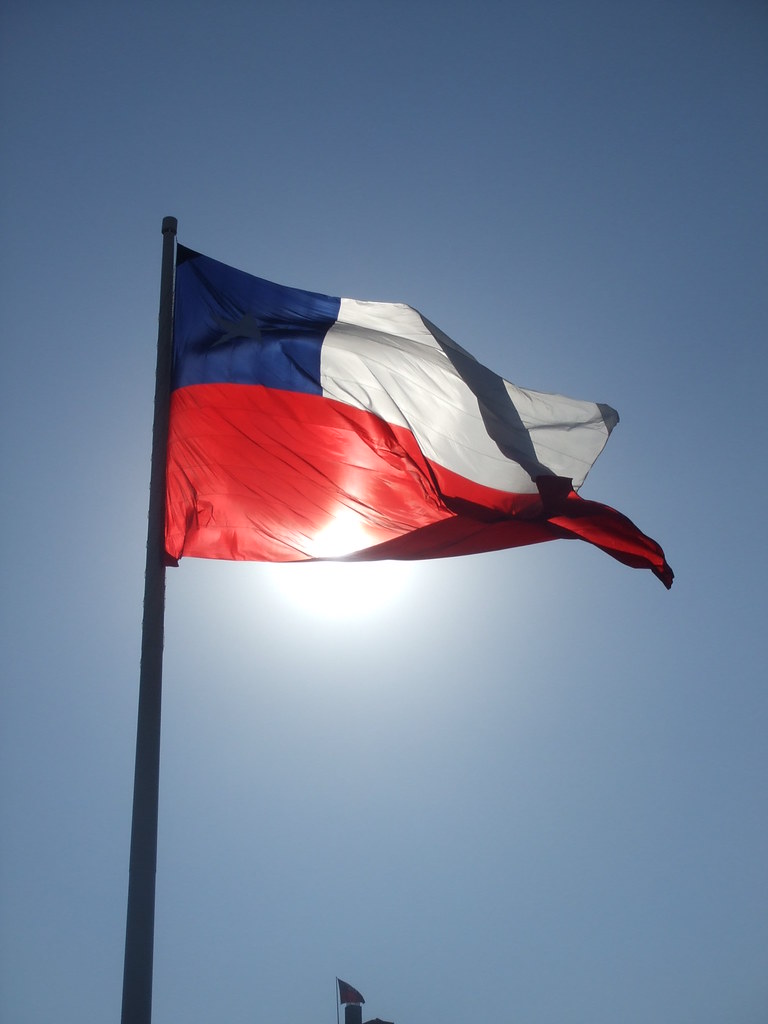
Chile's pride is symbolised in the great
bicentennial flag
But all that has started to change. First came the great earthquake of February 27th 2010, now the sixth largest in recorded history, which started to peel open people's eyes. Then came the rescue of the 33 miners, where over a billion people worldwide had their eyes glued to the TV. Finally, yesterday, President Obama chose Chile to be the stage upon which he announced a new type of relationship between the United States and Latin America - as equal partners. Not the world superpower and its underdeveloped cousins. Two equals with much to share and learn from each other.

The US President had high praise for Chile: "Credit for Chile’s success belongs to the Chilean people, whose courage, sacrifices and perseverance built this nation into the leader that it is. [...] So I could not imagine a more fitting place to discuss the new era of partnership that the United States is pursuing not only with Chile, but across the Americas."

With all eyes once again on Chile, word is beginning to spread. Perhaps soon, I will no longer being asked in an incredulous tone: "Why Chile?"

Tuesday, 8 March 2011

Immigration

Today was a big day. Today was the day I did the scariest thing I've done so far in Chile: renew my tourist visa.

It may not sound like much, but I had been warned of mountains of bureaucracy and hours of queuing. And more pertinently for me, I faced three big fears:
  • language - not understanding what I was being asked;
  • orientation - not knowing what I was supposed to do and where and when;
  • expulsion - a personal paranoia, but a fear that I may do something wrong and have my request to stay refused.
So, I got up early, armed with insider knowledge about the process from a colleague of Carlos' but without my usual trusty translator, and took myself down to the extranjería or immigration office.

Upon arrival, I quickly located the queue I'd been warned about - it reached out the door, snaked around the landing and started to go up the stairs. I cleared the first hurdle of asking the person in front of me if it was the right queue and lined up alongside the other, mainly Peruvian, migrants.

Thankfully, the queue moved quickly and within around 15 minutes I was issued with a number and told to go downstairs to the tourist department. Being one of the first, I was soon called by a man who seemed reasonably friendly, slightly bored, but with quite a stern face. I timidly bid him good morning and sat down asking to extend my tourist visa.

Annoyingly, I cannot say the proper word for an 'extension' as it involves both a single and a double 'r': prórroga. This is the worst possible combination of sounds for me, which my poor tongue just can't get itself around. But I think he got the gist as he started to type into his computer.

"¿Estado civil?" he asks me. Oh! I know this one! "Soltera" I answer, relief evident on my face.

"¿Profesión?" This flusters me a little. I don't have a profession, and I certainly don't have a job in Chile otherwise I wouldn't be applying for a tourist visa, right? Eventually, I plump for "Editora". Now that didn't look suspicious. Much later, I remember that in Chile people still have the concept of a profession - i.e. they go to university to train in a particular field and that takes them onto jobs within that field. They are qualified as a journalist or a specialist in a public relations etc. but there are no sideways career moves. They don't study English Literature and then wander into marketing via copywriting and web management.

Anyway, next question. "Blah blah blah... en Chile?" This could be how long are you planning to be in Chile but this is a formal procedure so I'd better not guess. I ask him to repeat: "blah blah blah... en Chile?" Oh god. I still didn't catch it. After what feels like an eternity of mumbling and bumbling, I manage to bluster: "la pregunta es...?" ("the question is...?") and look at him inquisitively. "Di-rec-ción" he says pointedly. Ah! Address! The street name trips off my tongue. Then - oh no! - I've never given my address in Spanish before. How on earth do you say one thousand four hundred and five again? Big numbers are not my strong point.

I get through it and then with one last moment of hilarity, which finally manages to crack a smile on this poor man's face, I tell him the last digit of my phone number is "snow" - "nieve" instead of "nueve". It could have been worse.

After this there's a bit more to-ing and fro-ing, having to walk to a nearby bank to pay the admin fee, then go back to the same office, but this time without a number as I was told I didn't need one, just to go there directly.

Being British, I didn't like to stride back up to the desk, so I sat at the back of the room for a while trying to suss out my tactics, until a kindly French girl (who showed up my linguistic inadequacy by talking to me in English when I didn't understand her Spanish) told me that unless I pushed in I was going to sit there all afternoon because without a number I was never going to get called. So I mustered as much latina as I could and plonked myself back down in front of the same guy. And was finally rewarded with my extended visa!

Saturday, 5 March 2011

Museum of Memory and Human Rights

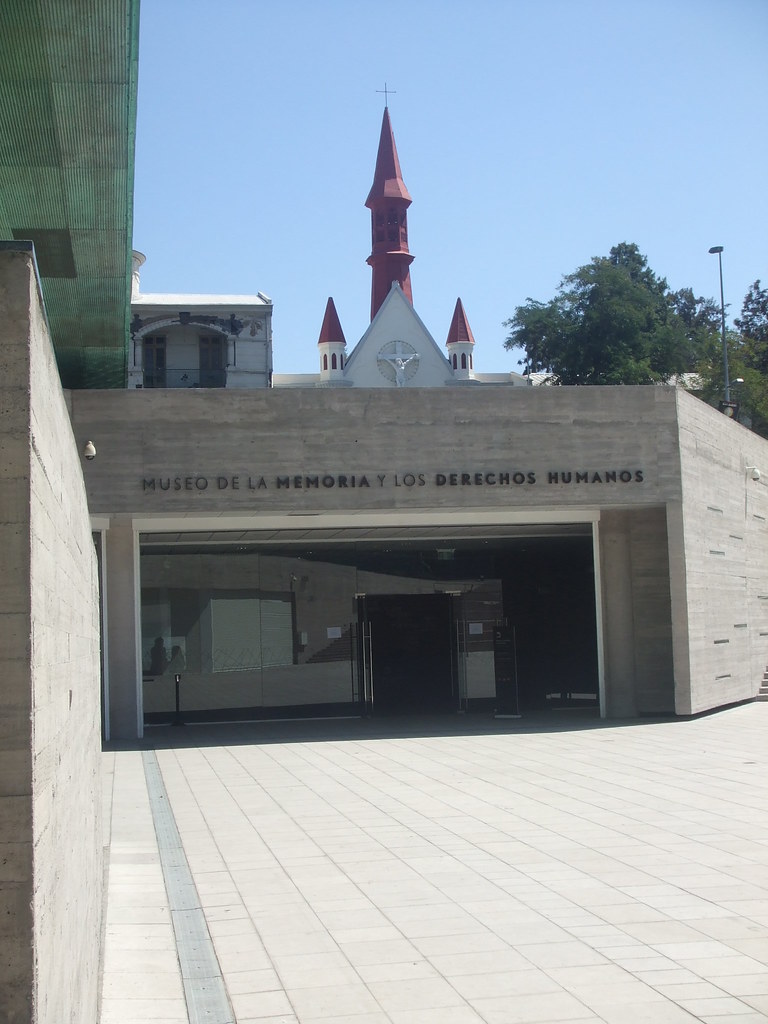
Entrance to the Museum of Memory
and Human Rights
Anyone who travels to Chile, without fail, should visit the Museum of Memory and Human Rights. Opened in January last year, the museum serves as a sensitive but profound record of the atrocities committed in the country under the military dictatorship of General Augusto Pinochet, between 1973 and 1990.

I had wanted to visit this museum for some time, but each day I had planned to go, I found myself reluctant to leave the house, knowing that it would be an upsetting experience. It was, of course. But it was also a crucially important account of Chile's history, which has given me insight into what makes Chile the country it is today.

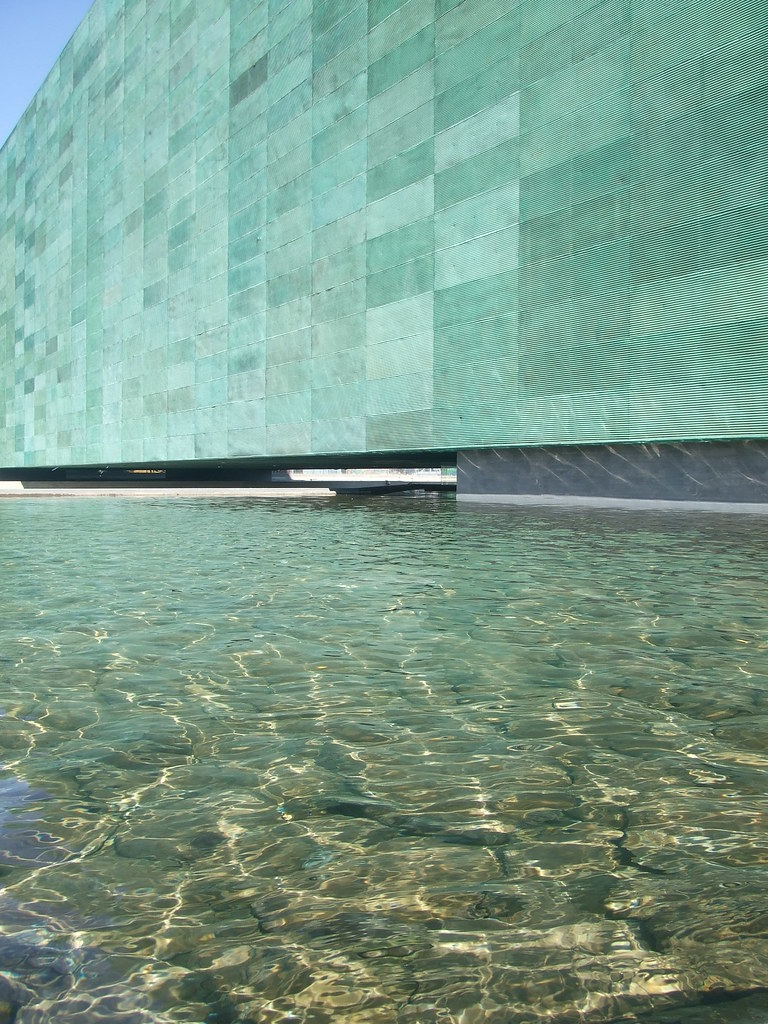
The waters surrounding the museum
The modern building uses architectural design at its best to express the different moods housed within the museum. From the outside, the venue looks impregnable; set low in the ground, the concrete entrance, hidden from view, looks like a kind of bunker. Surrounded by a large artificial pond, the rippling water creates a sense of calm. Inside, the country's darkest hour is contained within claustrophobic cubicles of black walls and minimal lighting, a new shock lurking round every corner. By way of contrast, a sun flooded corridor with a wall and ceiling entirely of glass runs the length of the exhibition space, providing a tranquil retreat to draw breath and reflect.

Stories are told through hard-hitting video footage - both news reports from the time and present day testimonies of those that survived. Seeing these people talk, often close to breaking down, drives home the reality of the situation. This is not just a story from the history books. People the same as you and I were subjected to the most brutal treatment. While I have enjoyed the liberties of education, culture and freedom of expression, people my age - and people who I now know - witnessed family members being taken by force, never to be seen again.

I would like to tell you more about the museum, and the deeply moving material it contains, but its power lies in being experienced. Please, if you come to Chile, make sure you include this museum in your list of must-sees. We must remember so that we do not forget.