Showing posts with label Earthquakes. Show all posts

Sunday, 26 June 2011

Addendum: Volcán Puyehue

When I moved to Chile, I was aware that there were certain risks involved. Earthquakes for example. And so, I was prepared. I read up on what we needed to do, I made sure we had a stock cupboard full of emergency supplies, and I practised running under the table to make sure I'd fit. With time, I've become accustomed to feeling the ground shake and to hearing our apartment building go bang now and again.

What I wasn't prepared for, was volcanoes. Volcanoes to me are the stuff of legend. They happen in Pompeii, in ancient times, or in Iceland, where the whole landscape is volcanic. Of course I know that Chile is located on the Pacific ring of fire. That's why it has earthquakes, right? But duh, it also means it has volcanoes. Active ones.

So there we are, happily living the high life in Termas de Puyehue. From our balcony window we can see the snow-covered Volcán Puyehue, sitting in the Caulle volcanic range. It hasn't erupted in more than five decades. Carlos casually tells me that he saw a puff of smoke from the range during his cabalgata. This, he was told, is quite normal, especially in winter, where obviously the difference between the air temperature and that of the volcanic crater means more steam gets produced. It's when there's smoke in the heat of summer, or no smoke for days, that the locals start to worry.
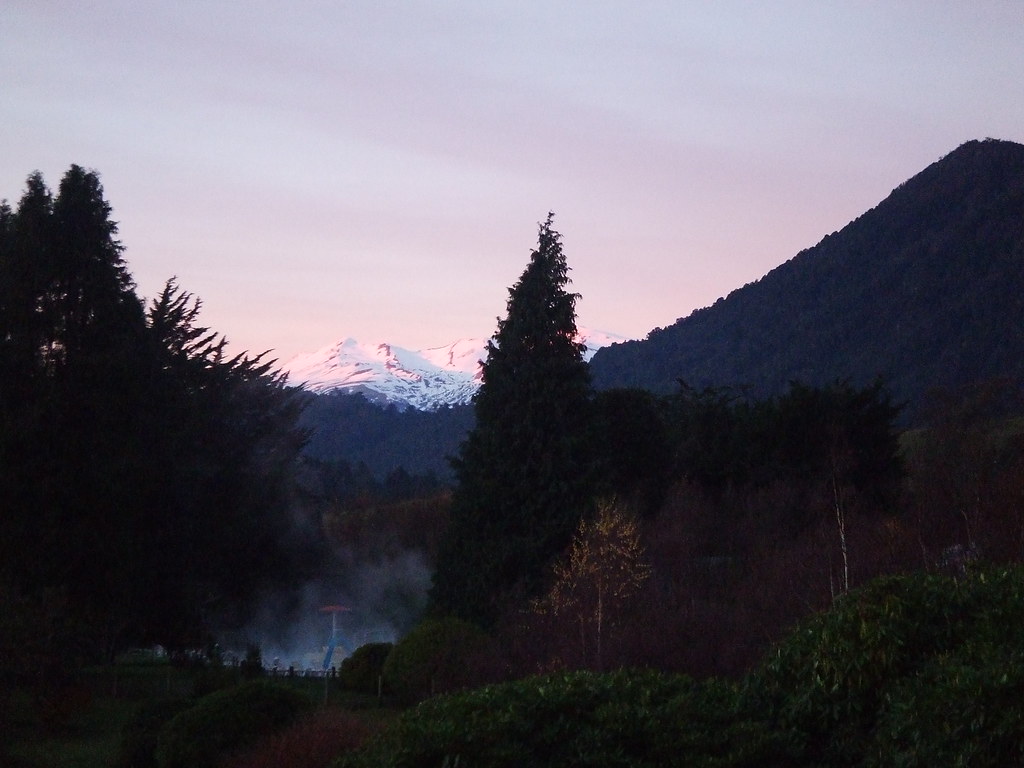
 Volcán Puyehue, before it erupted

A couple of days later in Valdivia, we see on the morning news predictions of a seismic swarm for Puyehue - a series of smallish earthquakes in close succession. How exciting we think, and how funny that we were there just a few days before.

In Pucón, we giggle at a volcano warning system, joking to ourselves that we wouldn't be hanging around to watch the light change to red if there was smoke billowing from the crater of Volcán Villarrica. I lament that I've spent the whole week around volcanoes and have yet to see any smoke, annoyed but in good humour that Carlos has and I haven't.

Happily we return home from our holiday, go to sleep for a few hours before hooking ourselves back up to the internet to see what we've missed during the previous 9 days. It's then that I see the messages on Facebook. Where are you? Have you left Puyehue? Are you stuck waiting for a flight? It's then that I discover that as we were sitting in Pucón bus terminal, that volcano that from the hot volcanic springs of Puyehue we'd watch turn pink with the sunset, had exploded.

Over the coming days, as I return to my day job and start writing news stories about it, we discover that large parts of the region we had been staying in days before had been evacuated. The pass over the mountains to Argentina is closed. And the most beautiful place on earth is covered with ash, Bariloche's crystal blue waters grey with sediment.

It's then that I realise we've had a lucky escape, and that with a landscape of such great beauty, must come respect for the earth that created it.

Some of my stories about the Puyehue volcano:

Sunday, 19 June 2011

City of rivers

Pinnacle of the holiday finally achieved, we moved onto Valdivia - the urban centre and capital of Los Rios region. Valdivia is famous for being the location of the world's biggest ever recorded earthquake - a huge 9.5 on the Richter scale in 1960. It's also famous for its German influences, beer, fish market, rivers and sea lions!

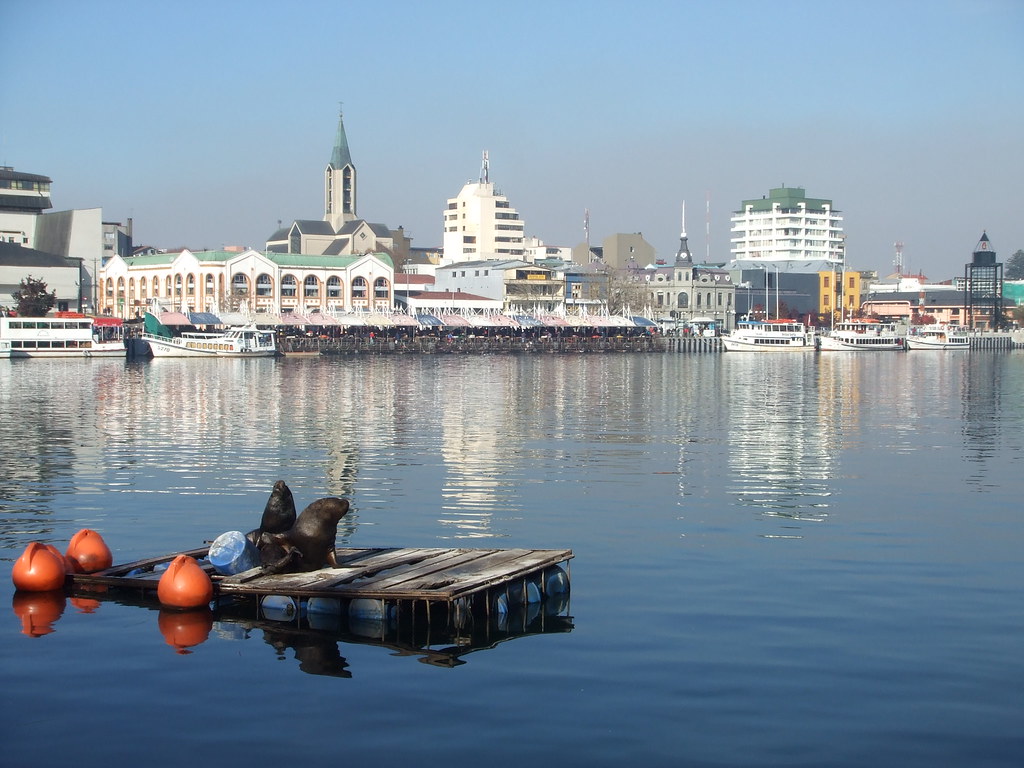
The day began shrouded in dense fog as we ambled along the waterfront trying to avoid the grasp of the plethora of pleasure boat trip sellers keen to seize on a couple of tourists. In addition to the rather yummy looking fish market (a pity we couldn't cook that night), the waterfront also boasts a massive submarine and a pendulum clock that tells the time based on the curvature of the earth. And how could I forget? The waterfront is also home to loads of (rather smelly) sea lions, who lounge around all day except for when the market clears up at night...

My picture postcard of Valdivia's waterfront (and sea lions)

While we were waiting for the skies to clear, we decided to take in a few museums. The first was the Kunstmann brewery (cerveceria) - which we took a short micro trip to get to. Now, we were expecting something on the scale of the Guinness Storehouse in Dublin. Not to be I'm afraid; the brewery has a small museum and shop and a large restaurant. Still, it was interesting to learn about this family business, started by German immigrants who first arrived in the mid 1800s, which now competes on a global sale. The honey ale is particularly nice.

Philippi (right) and friend.
I love this photo, nothing says 'Victorian
explorer' more.
Back in the town centre, the sun had broken through so we enjoyed our sandwiches on the riverside - at a safe distance away from the hungry lobos marinos (sea lions). Afterwards, we crossed the river to the university side of town (Valdivia is an important student city) and visited two more museums. The first was an historical and anthropological museum that contained artefacts from the region's various colonisers, from the Mapuches to the Spanish to the Germans.

The second was the Philippi museum of exploration. The observant amongst you will remember I mentioned Philippi in my post about Puerto Varas. Despite the sound of the name, Philippi was a German explorer who 'discovered' a large part of the regions of Los Rios and Los Lagos. A palaeontologist and zoologist, he worked extensively to categorise and document life in this exotic land, which at the time consisted mainly of dense forest.

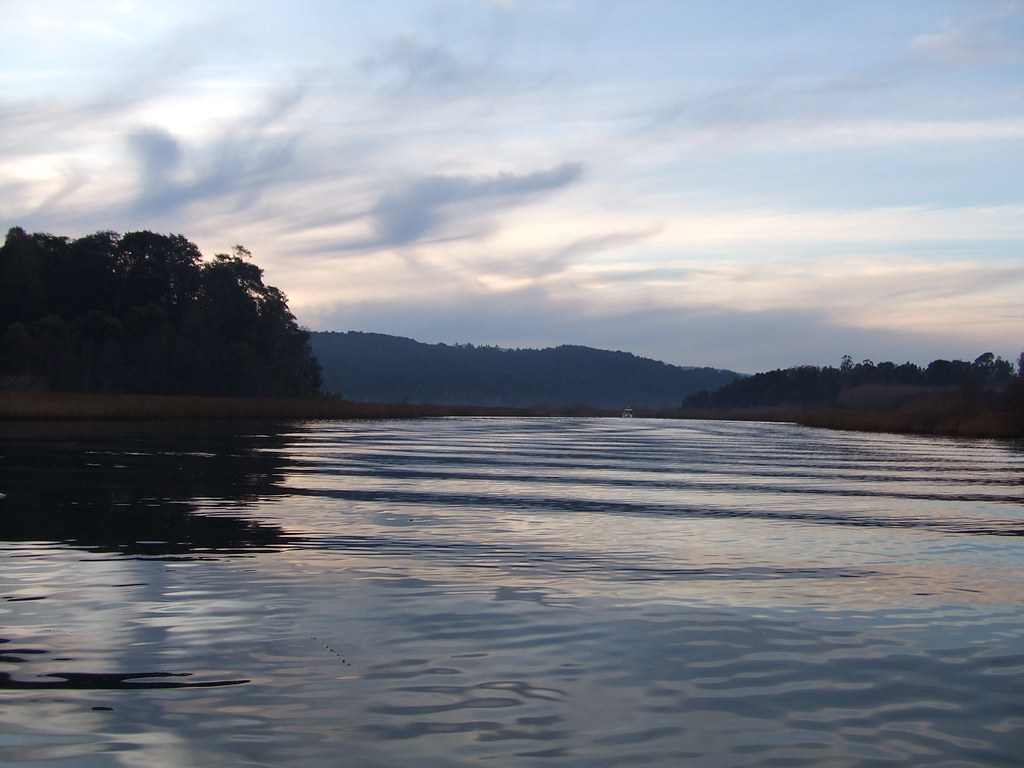
Full of information, we decided to finish off the day with one of the riverboat tours we had an initially been avoiding. Thankfully, we made a good choice - a sturdy boat, a very informative guide and a decent long tour along the Valdivia, Cau Cau and Cruces rivers. Another sunset in another romantic place.

Valdivia, city of rivers

More Valdivia photos on Flickr:

www.flickr.com

jaynescarman's Valdivia photoset jaynescarman's Valdivia photoset

Tuesday, 22 March 2011

All eyes on Chile... again

As I write this, I'm recovering from another news marathon at I Love Chile. This week, it was the visit of US President Barack Obama. As the only English media group in Chile, we were fortunate to get press passes to the official proceedings, giving our reporters and photographers a nice close up of this important meeting. I may have been office bound, watching events unfold on the Chilean government's live stream, but nonetheless, it was exciting to be part of capturing such an historic occasion.

More and more it seems, Chile is muscling its way onto the world stage. It embarrasses me to say, that I don't think I could have pointed to Chile on a map when I first learned this was going to be home for the next year. Like many of my compatriots, I knew little about this long slither of land at the end of the world.

I've often mused about why this is. Without doubt, geographically, the country is isolated. The majestic Andes form a natural barrier to the east, while the expanse of the Pacific Ocean stretches out to the west. In the north lies the unforgiving Atacama Desert - which in places supports no life - and in the south, Antarctica, the last wilderness on Earth.

Migration, at least between much of Europe and Chile, has historically been fairly low. And until 2010, there was little in the way of cultural or social exports that reached across the Atlantic to make the non-Latin parts of the northern hemisphere stand up and take notice.

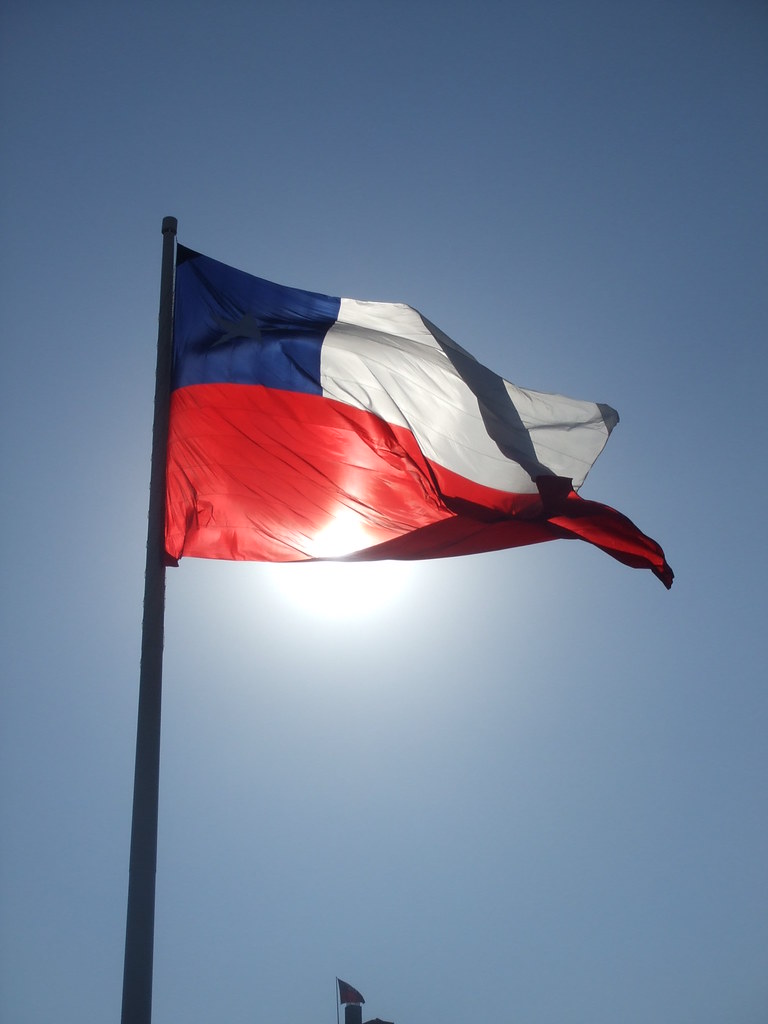
Chile's pride is symbolised in the great
bicentennial flag
But all that has started to change. First came the great earthquake of February 27th 2010, now the sixth largest in recorded history, which started to peel open people's eyes. Then came the rescue of the 33 miners, where over a billion people worldwide had their eyes glued to the TV. Finally, yesterday, President Obama chose Chile to be the stage upon which he announced a new type of relationship between the United States and Latin America - as equal partners. Not the world superpower and its underdeveloped cousins. Two equals with much to share and learn from each other.

The US President had high praise for Chile: "Credit for Chile’s success belongs to the Chilean people, whose courage, sacrifices and perseverance built this nation into the leader that it is. [...] So I could not imagine a more fitting place to discuss the new era of partnership that the United States is pursuing not only with Chile, but across the Americas."

With all eyes once again on Chile, word is beginning to spread. Perhaps soon, I will no longer being asked in an incredulous tone: "Why Chile?"

Sunday, 27 February 2011

One year on

I could write about nothing else today other than the first anniversary of the great Chilean earthquake of 2010.

At 3.34am on February 27th 2010, a massive earthquake measuring 8.8 on the Richter scale hit Chile. Its epicenter was just offshore from Cobquecura, a small town in the central-southern part of the country. Around 30 minutes later, massive tsunami waves triggered by the quake hit Chile's coast, destroying large parts of the country's second city Concepción.

Here in the capital city of Santiago, where the quake measured around 8.0, there was surprisingly little damage. While lots of buildings suffered some surface damage, there was little in the way of major structural problems. Testament to this, our flat had some sizeable cracks in its central walls and a few tiles that had fallen off when we moved in. And like many people we know, our doors don't close properly and the windows don't open without a fight. But the building is standing and sturdy. Reports in the news say that it was business as usual in Santiago after only a couple of days.

In total, the earthquake caused the deaths of 524 people, left 31 missing and 800,000 homeless. But what's amazing, is that these numbers are pretty small. Compare it to the Haiti earthquake just six weeks earlier; this measured 7.0 on the Richter scale, but is thought to have killed over 300,000 people, injured a further 300,000 and left 1 million people homeless. This just goes to show how well prepared Chile is. It understands the risks of its location and knows how to deal with them.

Read my articles about the February 27th earthquake on I Love Chile:

Monday, 3 January 2011

What a year for Chile... and for me

2010 - a year of huge ups and downs for Chile. For me - a year of life-changing experiences.

It's not often in life you are given the opportunity to do something completely new. To actually realise a dream you may have had, or half had, for years, never really thinking it was achievable. But for me, 2010 presented just that; an opportunity to live abroad, to visit south America, to immerse myself entirely in a new culture and language.

For my newly adopted country, 2010 was, to put it mildly, an interesting year. Many of us in the northern hemisphere probably learned more about Chile in the media last year than ever before, as for both good and bad reasons, it made headlines. Certainly, nothing ordinary happened.

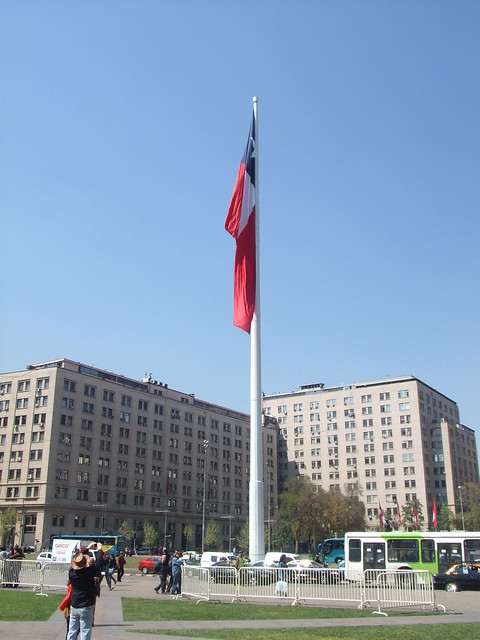
The great Chilean flag
To start with, 2010 was Chile's bicentenary. 200 years ago, on the 18th September 1810, a group of Chilean-born citizens began the process of independence from Spain. To mark the occasion, an extensive programme of events was planned: an enormous national flag was proudly unfurled in the centre of Santiago; a new museum of memory and human rights opened to remember victims of the military dictatorship; over 17 million trees were planted, one native species for every Chilean; several national monuments and public spaces were overhauled and revitalized, including Santiago Cathedral; construction started on a national network of bicycle paths - 690 miles worth; and various cultural and artistic events took place, including the special performance of The Nutcracker in the grounds of La Moneda.

It was due to be a year of great excitement, hope and celebration. Then out of nowhere, on February 27th, at 3:34 local time, a massive earthquake struck the country. Measuring 8.8 on the Richter Scale, the quake affected large swathes of the country and triggered a devastating tsunami that destroyed extensive areas of the coast. The infrastructure, including the main route connecting the capital with the south of the country, was badly damaged. Hundreds of thousands of people were made homeless, food was scarce, the drinking water supply contaminated and a complete blackout lasted for several days. A state of national catastrophe was declared.

However, despite the severity of the quake (bigger than the Haiti quake earlier in the year), Chile quickly set-about the task of re-building. And the nation showed its strength and solidarity in a special Telethon, named Chile helps Chile, which raised double its target to kick-start the country's recovery. In total, over 50 billion Chilean pesos was collected (that's over 68.5 million pounds).

Two weeks after the earthquake, a new president assumed office. Sebastián Piñera, a media mogul and one of the country's richest people, is Chile's first democratically elected right-wing president since 1958. This was a major political shift, which saw him replace the hugely popular Michelle Bachelet, who left office with an approval rating of around 80% (the Chilean Constitution prevents presidents from serving consecutive terms).

In June, there was some light relief and great excitement as Chile took part in the World Cup for the first time since 1998. The national team, 'La Roja', played some impressive football, eventually losing to Brazil in the second round.

The miners' rescue capsule
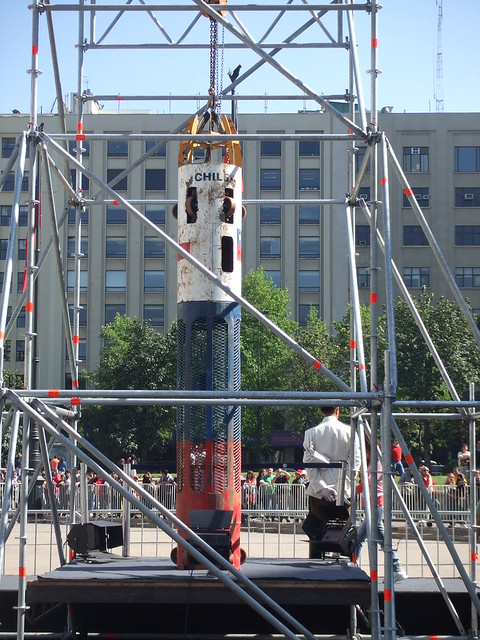
Then in August, Chile hit the headlines of the world, with the news of 33 miners, trapped at a depth of 700 meters when the mine they were working in collapsed, were found alive and well after 17 days. They of course went on to spend a total of 69 days underground before being dramatically rescued on October 13th. The eyes of the world were on Chile and the miners and their families received the fairytale ending they could probably never have imagined.

But the emotional rollercoaster didn't end there. Tragedy struck again in December when a fire in an overcrowded prison killed 81 inmates. While a second Telethon raised over 18 billion pesos, uniting the country once again in a drive to help disabled children.

Any one of these events would have been enough for a country. So what will 2011 have in store for Chile? After a year of jubilation, despair, tragedies and fairytale endings, perhaps the citizens of this country are hoping for something a little less out-of-the-ordinary.

Thursday, 2 December 2010

I felt the earth move

Ok, I've decided to tackle a subject here that I've shied away from previously, because at times when I have mentioned it in the past it has provoked quite a strong reaction. The subject: earthquakes.

Here in Chile, earthquakes are a fact of life. Most likely, you will have seen in the news that Chile had a major earthquake back in February this year. In that particular case, the magnitude was exceptional. But a gentle shaking of the earth here is a regular occurrence.

I experienced my first tremor around four days after I arrived. I was sitting on the sofa when I heard an odd creaking noise in the kitchen. My first thought was that something may have fallen down or come in through the window. But then 30 seconds later I felt the floor and the sofa shake. It couldn't have lasted for more than 10 seconds and was nowhere near as strong as those we've had in Birmingham in recent years.

Since then there have been countless tremors, or rather delightfully 'tremblers' as they are sometimes called. I've been aware of two or three and there have been many more while we've been asleep/on the Metro/out and and about. What prompted this post was another one this morning and I can only describe it as feeling like someone had grabbed hold of the bottom of the sofa and shaken it from side to side.

So there you have it. Unfortunately, I couldn't write a blog about my time here in Chile without mentioning earthquakes, they are so common that no-one is phased when the earth moves. In fact, some colleagues of a friend of mine simply grinned and said: "Welcome to Chile. Get used to it." (Thanks Emma)

Friday, 1 October 2010

How does an earthquake cause a sore head?

Answer: if it comes in a glass 
 
A terremoto

Last night I had my first 'night out' in Santiago and was taken by Carlos and his colleagues to a delightful bar called (rather aptly) 'the fleapit' (La Piojera). Imagine, you go down a dark, packed, cobbled alleyway into an even more overcrowded basement bar - bare floor, rustic-looking tables and chairs, glasses and paper napkins littered everywhere, conversations pitched at ear-blistering decibels, lots of jostling and folk musicians playing in the corner. Needless to say, the sharp suits of the accountants and lawyers I was with were an interesting, if incongruous, addition to the mix.

Anyway, the drink of choice in said establishment is the 'terremoto' or 'earthquake'. This drink is legendary in Santiago and consists of a pint of sweet fermented wine with 4-5 scoops of pineapple ice-cream on top, all served in a plastic tumbler. It may also contain some sort of liquor but I didn't quite get to the bottom of that.

Needless to say, the drink gets its name from its ability to make the ground move beneath you and I can certainly say it did. Carlos and I had one each to last us the whole evening and found ourselves staggering home. And I suddenly discovered an amazing fluency in Spanish which I do not have in my lessons!