Showing posts with label Language. Show all posts

Sunday, 21 August 2011

Final observations

Or blog posts that didn't quite make it to fruition

With just 48 hours left of our time in Chile, it's a sure-fire fact that there are a million and one things that I still want to write about. Here's a selection of snippets of observations that have been floating around my brain but as yet haven't made it on to paper.

Traffic

Traffic in Santiago drives Carlos and I completely round the bend (excuse the pun). Beeping the horn is as obligatory as gear changes and takes the place of a dawn chorus in the early morning rush hour. While traffic lights here signify the following actions:

  • Green light - zoom through as fast as you can, beeping the horn at anyone who happens to slow down or stop for any reason, be that for congestion, red traffic lights up ahead, a stray pedestrian or because they've crashed into a fence (yep, we watched this happen).

  • Amber light - speed up even more to make sure you get through before the lights 'change' (no preparing to stop here).

  • Red light - only takes effect after the first 5 or 6 cars have gone though the red light. Likewise, traffic starts moving again from around 30 seconds before the lights change to green (or the driver's patience is at an end, whichever is the shortest).

      "Mani, mani, cuchufli"*

      Chileans are an industrious and resourceful nation. Whenever there is an occasion to sell something, you can guarantee there's a vendor right there. Roaming sellers are ubiquitous; whether on the street, at the Metro entrance or in the micro, you can pick up everything from Super Ochos, to tights, to plasters, to sewing thread.

      Of course there is a serious side to this, as this on-the-hoof selling is how many, many Chileans make a living. But the funniest thing (at least to us) is the appropriateness of the goods. If it's a hot day - it's ice-creams, a chance of rain - umbrellas, new year - yellow underwear, football match - vuvuzelas and silly hats. And the best I've seen so far is a kid selling lemons in the middle of a demonstration, to help participants counteract the effects of tear gas!

      You will also never go hungry in Chile as "catering" (pronounced as cat not Kate) is rife. Concerts, beaches and parks all ring with the sound of "mani, mani, cuchufli". It's become a running joke between us now, that even in the most isolated spots like the Tatio geysers, there will probably be someone with a cardboard box full of goodies.

      *Mani = peanuts; Cuchufli = a tube of pastry filled with manjar and covered in chocolate; Manjar = sweetened condensed milk boiled to a caramel-like consistency; Super Ocho = a chocolate covered wafer bar


      Car alarms

      Car alarms are musical here in Chile. My first jetlagged experience was trying to sleep while a flypast went low overhead as part of the Fiestas Patrias celebrations continually setting off a cacophony of alarms. Eventually, it reached the point that Carlos and I could sing along. Something like:

      Ner - nir - ner - nir, nuuuurgh - nuuuurgh, woo woo woo woo woo woo woo woo wooo, ne ne ne ne ne ne ne ne, mwik miwk miwk miwk.

      You get the picture.


      Isabel Allende

      Going all serious for the moment, I never had the opportunity to follow up on my New Heroes post and write about Isabel Allende. I read her excellent book The House of the Spirits, which is basically the history of Chile in fictional form, which deals with everything from post-colonial feudalism to state torture under the dictatorship. I like her for her presentation of strong women in her novels, within a society that is very male dominated.


      On being a giant

      This is the mirror that every other woman checks their
      hair and make-up in on the way to the Metro
      Right back at the beginning of my stay here in Chile I observed how freakishly tall I am in this country and how it leads to a lot of eyes turning in my direction. Sadly for me, this hasn't got any better. I still have to endure the entire Metro carriage looking at me with curiosity as I stand there trying not to get too flustered. I still get in the way in department stores and bash into things (nothing new there then) and I still find myself able to see over the top of toilet doors. And I still terrify the occasional child.

      While I may have learnt the hard way the value of ducking my head, I'm looking forward to only being slighter taller than average and not a startling object of wonder.


      Yo Hablo Chileno

      It's hugely well documented that coming to Chile will supposedly ruin your Spanish. Or that if you can understand Spanish here, you can do it anywhere. Now, I'm not one to judge, but I will agree that there is a great deal of slang and that the pace and pronunciation make navigating conversations a challenge at times. But despite my consciousness that I would eventually be speaking Spanish with Spaniards, I hadn't realised quite how 'Chileno' was my vocabulary until Carlos and I sat today making a list of all the words that I know that are not used in Spain. Oh, and when we tried to buy slices of ham in the supermarket last weekend and it was me that the assistant could understand and not Carlos! Here's to the very strange combination of a Brit speaking Chileno with family from northern Spain on my next visit to Zaragoza...

      Saturday, 20 August 2011

      Return to the '80s

      Here's something I hadn't expected to find in Chile (picture below):

      A slightly famous wedding dress
      The fashion conscious or royalists amongst you will know that this is Princess Diana's wedding dress. Not the actual gown, but one of the versions that went into designing the final ensemble, worn by the late princess for her wedding to Prince Charles in 1981.

      But what on earth is it doing in Chile?

      Well, a couple of weeks ago I made my second visit to the fantastic Museo de la Moda (fashion museum) in Vitacura, Santiago. I first went on my birthday, way, way back in October when I knew nothing about Chile, was feeling extremely alienated and homesick and really needed to do something to cheer myself up. This time I found myself strolling up without getting lost, chewing on a Super 8 (it's a Chilean chocolate biscuit bar) and buying my ticket in Spanish with ease. No guided tour in English for me this time! How things change...

      Back to the Future
      I was visiting the second instalment of the museum's Return to the '80s exhibition (Volver a los '80s II) which has its centre piece the car/time machine from the film Back to the Future along with protagonist Marty McFly's jacket. Pretty cool, but of course I was there for the fashion.

      A new room has been added with an exhibition about Body Map, London-based designers that were highly influential in the fashion world of the era, dressing the likes of Boy George.

      The other rooms followed the same format as before - street fashion, celebrities, designer and couture. It was in the celebrity room that I stumbled across Princess Diana's dress, along with a pink full-length shoulder-padded gown belonging to Joan Collins and items from Madonna and Duran Duran.

      Chanel in the 'disco' room
      The designer section continued to dazzle, with cases from Jean-Paul Gautier (more conical bras), John Galliano, Armani, Issey Miyake, Thierry Muglar and Vivienne Westwood. Then downstairs in the 'disco' room (with very loud music and so dark I could hardly read the notes) was what I've labelled 'couture', beautiful, beautiful, beautiful tailoring from the likes of Chanel and Yves Saint Lauren, as well as a Chilean designer, Ruben Campos.

      What I found most interesting this time, was my greater appreciation of the context of the exhibition. I watched for the second time a video that explains the making of the exhibition and which includes various famous Chileans from the decade talking about their experiences of the fashion and culture of the '80s and Chilean society at the time.

      For a start, I recognised a lot more of the faces and many of the cultural references were no longer alien to me. But I also felt like I understood what they were saying a little more, and not just in terms of the language.

      Chile has an odd affair with the '80s. The entire decade was lived through the dictatorship, with curfews and repression and very little exposure to outside influences. And yet today there exists a massive nostalgia for the music and fashion. Whether it's because people feel they missed out, or because the world being lived by New York and London was such a polarity to what was permitted in Chile at the time, I don't know and I'm in no place to speculate. But it was insightful to realise that mutually, Chile and I have got under each other's skin.

      Sunday, 12 June 2011

      How the other half live

      Cross the border back into Chile from Argentina's Bariloche and the international road will take you right past Termas de Puyehue. A little all inclusive stay at this super-luxurious spa and wellness resort was my treat from I Love Chile for the voluntary work I've been doing for them over the last six months. Seriously, this was some present.

      We were up early to catch the international bus from Bariloche's terminal. Amusingly, we were shown the same film as on the inbound journey, but hey, it was an enjoyable one (Tony Scott's 'Unstoppable' about a runaway train if you're interested, dubbed into Spanish of course)! After passing through customs without incident, the bus dropped us off at the entrance to the termas. 


      A progressive series of 'wows' followed, as we entered a huge reception area and were shown to our enormous and sumptuous room complete with balcony, lake view and various little freebies. After we'd picked ourselves up off the floor, we decided to find out about the various activities on offer before having lunch.

      The view from our window

      The all inclusive deal involves a buffet breakfast, lunch and dinner, at least three courses each time. Needless to say my jeans were a little tight by the end. The main restaurant has an idyllic view of the grounds and the lake beyond and we even managed to watch some birds of prey outside while breakfasting on the last morning (sorry, this was a rare occasion where I didn't have my camera with me).

      The view from the restaurant


      Following lunch, we were taken on a short guided walk (caminata) to the complex's hydroelectricity plant - the turbine dating from the 1930s - before hitting the pool. Hot spring pools are one of the best discoveries I've made here in Chile (you'll see why in a forthcoming post about Nevados de Chillan). Naturally heated by the area's volcanic underground (more on that later too), the pools are extremely relaxing and the minerals in the water make your skin feel really soft.

      At Puyehue, there is a large indoor pool heated at around 36 degrees with various hydro-massage jets which we had great fun trying not to get thrown about by. Next to it there is a semi-covered Olympic-sized pool, in which I had a gorgeous early morning swim the next day, and lastly an outdoor 'fun' pool. We messed around in the outdoor pool as the sun went down, being swirled around in a whirlpool, bumped around by water jets and generally acting like big kids.

      Local yarn
      The next morning, Carlos took advantage of a horse riding trip (cabalgata) while I returned to the pool and pottered around the hotel. I figured my first time on a horse in a language I'm still learning was not the best of ideas. Part of the pottering involved a quick visit to the hotel shop, which to my dismay, held an ample collection of local yarn. You guessed it, I bought some (and it's green).

      When we met-up again, we had a packed day ahead of us, starting with a mountain-biking circuit around the grounds, a big lunch and a lovely walk through the forest along the river - where I learnt lots of countryside related vocabulary such as seta (fungus), enganchar (to be hooked on something - i.e. a rama or branch), barro (mud), otoñal (autumnal) and oveja (sheep). I hope that's painted a picture...

      Setas (funghi)

      Back in the hotel we took in onces - the Chilean version of afternoon tea, which includes bread, ham and cheese, cakes and of course, tea! Rather full, we headed to the spa for a sauna, which after feeling proud of ourselves that it wasn't that hot, we realised wasn't switched on. We sorted that though, before returning to the pool for a refreshing dip.

      That night's buffet consisted of traditional Chilean food, including empanadas and pastel de choclo. I enjoyed a kind of beef bourguignon and some of the best desserts - deep fried churro-like pastries and little meringues with fruits of the forest. Finally, we worked off dinner with an hour or so of ping-pong in the games room.

      Termas de Puyehue is an oasis of luxury, in a stunning setting, with attentive staff and immaculate attention to detail. It sounds like a cliche, but we kept returning to our room to find more treats - baskets of fruit, chocolates and bottles of the spa's mineral water. Hands down, Termas de Puyehue wins the award for 'the most luxurious place I've ever stayed'.

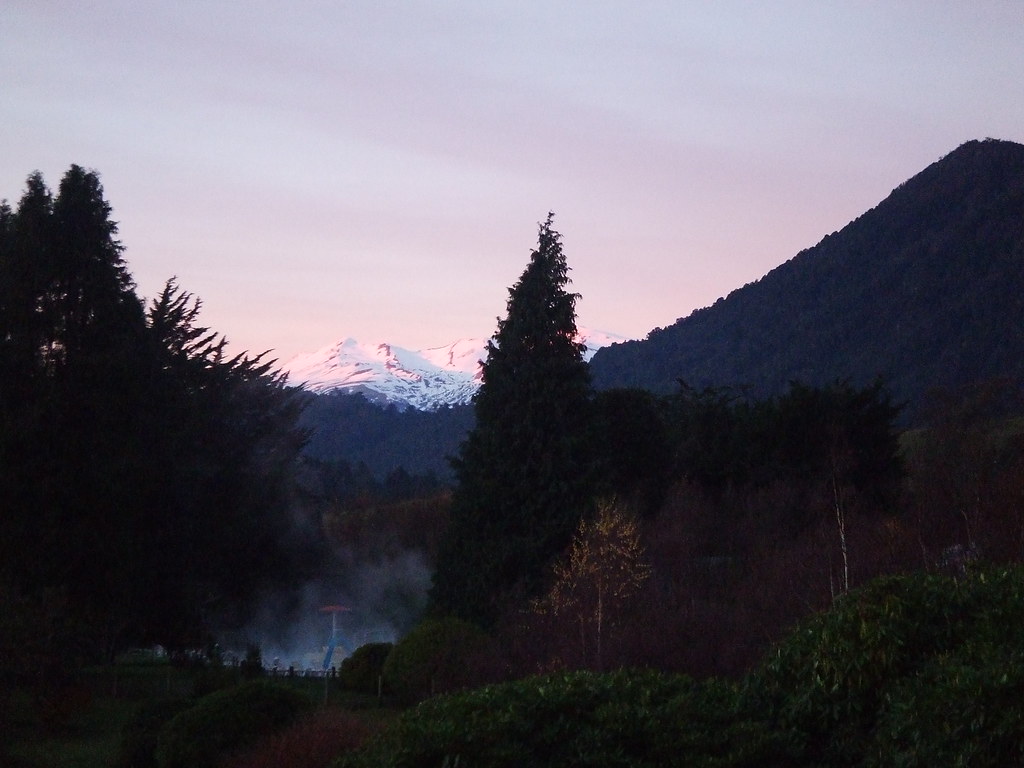
      Termas de Puyehue's grounds with Volcan Puyehue in the background
      and the hot spring pool in front

      More Termas de Puyehue photos on Flickr:

      www.flickr.com

      jaynescarman's Termas de Puyehue photoset jaynescarman's Termas de Puyehue photoset

      Tuesday, 8 March 2011

      Immigration

      Today was a big day. Today was the day I did the scariest thing I've done so far in Chile: renew my tourist visa.

      It may not sound like much, but I had been warned of mountains of bureaucracy and hours of queuing. And more pertinently for me, I faced three big fears:
      • language - not understanding what I was being asked;
      • orientation - not knowing what I was supposed to do and where and when;
      • expulsion - a personal paranoia, but a fear that I may do something wrong and have my request to stay refused.
      So, I got up early, armed with insider knowledge about the process from a colleague of Carlos' but without my usual trusty translator, and took myself down to the extranjería or immigration office.

      Upon arrival, I quickly located the queue I'd been warned about - it reached out the door, snaked around the landing and started to go up the stairs. I cleared the first hurdle of asking the person in front of me if it was the right queue and lined up alongside the other, mainly Peruvian, migrants.

      Thankfully, the queue moved quickly and within around 15 minutes I was issued with a number and told to go downstairs to the tourist department. Being one of the first, I was soon called by a man who seemed reasonably friendly, slightly bored, but with quite a stern face. I timidly bid him good morning and sat down asking to extend my tourist visa.

      Annoyingly, I cannot say the proper word for an 'extension' as it involves both a single and a double 'r': prórroga. This is the worst possible combination of sounds for me, which my poor tongue just can't get itself around. But I think he got the gist as he started to type into his computer.

      "¿Estado civil?" he asks me. Oh! I know this one! "Soltera" I answer, relief evident on my face.

      "¿Profesión?" This flusters me a little. I don't have a profession, and I certainly don't have a job in Chile otherwise I wouldn't be applying for a tourist visa, right? Eventually, I plump for "Editora". Now that didn't look suspicious. Much later, I remember that in Chile people still have the concept of a profession - i.e. they go to university to train in a particular field and that takes them onto jobs within that field. They are qualified as a journalist or a specialist in a public relations etc. but there are no sideways career moves. They don't study English Literature and then wander into marketing via copywriting and web management.

      Anyway, next question. "Blah blah blah... en Chile?" This could be how long are you planning to be in Chile but this is a formal procedure so I'd better not guess. I ask him to repeat: "blah blah blah... en Chile?" Oh god. I still didn't catch it. After what feels like an eternity of mumbling and bumbling, I manage to bluster: "la pregunta es...?" ("the question is...?") and look at him inquisitively. "Di-rec-ción" he says pointedly. Ah! Address! The street name trips off my tongue. Then - oh no! - I've never given my address in Spanish before. How on earth do you say one thousand four hundred and five again? Big numbers are not my strong point.

      I get through it and then with one last moment of hilarity, which finally manages to crack a smile on this poor man's face, I tell him the last digit of my phone number is "snow" - "nieve" instead of "nueve". It could have been worse.

      After this there's a bit more to-ing and fro-ing, having to walk to a nearby bank to pay the admin fee, then go back to the same office, but this time without a number as I was told I didn't need one, just to go there directly.

      Being British, I didn't like to stride back up to the desk, so I sat at the back of the room for a while trying to suss out my tactics, until a kindly French girl (who showed up my linguistic inadequacy by talking to me in English when I didn't understand her Spanish) told me that unless I pushed in I was going to sit there all afternoon because without a number I was never going to get called. So I mustered as much latina as I could and plonked myself back down in front of the same guy. And was finally rewarded with my extended visa!

      Wednesday, 17 November 2010

      6 x 7 anyone?

      I have a test coming up this week, which will ascertain whether I am ready to move up to the next level of Spanish classes. I don't feel particularly confident, so I have spent the last couple of days drilling. Hours and hours I have spent repeating over and over again lists of irregular verbs, conjugations for different tenses, formulas for making comparisons and expressing obligations and, of course, all the uses of the dreaded prepositions.

      Feeling like I was back at school, I came to the realisation that this is actually how you need to learn a language. It's all well and good taking a relaxed attitude and resting on the idea that because you are supposedly immersed in a language by living in a foreign country, you will automatically start to absorb it simply by osmosis.

      Up to a point, this is true; by being constantly exposed to a language you can't help but start to pick it up. However, to be able to function in a language, to have what you want to say ready on the tip of your tongue rather than finding yourself drifting off in mid-conversation while you cast your mind back to a lesson you were in once, for that you need to have the grammar cemented in your brain. And the only way to do that is to revisit your school days, when you sat at home reciting times tables in preparation for a test the next day.

      Saturday, 23 October 2010

      Learning the lingo

      There was good news this week. On Monday, I completed my 20th hour of Spanish lessons at Woodward Chile and so it was time for an assessment to check on my progress. And the good news was that I passed and have now started Spanish level 2!

      So far, learning Spanish has been a lot of fun but quite difficult. I arrived having studied Spanish at evening class for a year and was quite confident I could communicate on a basic level. How wrong I was. I had not been prepared for how different Spanish in Chile would sound. And even now, I almost always have no idea at all what people are saying to me.

      Firstly, people in Chile seem to speak quite fast. Of course, native speakers always speak faster than learners. But the Chileans I've dealt with, by their own admission, talk quite rapidly.

      They also seem to swallow their words. Again, probably quite a standard thing for native speakers - the final letters or syllables in words get lost or dropped and words run together.

      Then there's the difference in pronunciation. The Spanish that I have been used to is spoken with a th sound for the letters z and c, whereas here, s, c and z are all pronounced with a s sound. Getting used to the pronunciation is easy but it makes spelling a bit tricky.

      Add to this, changes in lexis. Lots of vocabulary is different from Spain. For example, the word for avocado (which Chileans eat a lot of) is palta, not aguacate. And don't even get me started on 'Chileanisms' - colloquial expressions and phrases which proliferate standard conversation.

      So as you can see, getting to grips with the local lingo is a challenge. One that both amuses and frustrates me in equal measure!

      Wednesday, 29 September 2010

      A day of small victories

      Ok, I have a confession to make. I'm afraid I have spent the majority of the past week hiding in our flat, too scared to go out and feeling both isolated and frustrated by my inability to communicate with the world outside. I have found that I can increasingly understand a lot of written Spanish, I can even utter a few sentences of my own, but when someone responds? Not a clue!

      However, this morning I have been extremely brave and forced myself outside the front door. And I am delighted to report the following small successes:
      • I managed to ask to send a letter to England at the post office, understand the price quoted and pay
      • I dropped in to a language school and enrolled for Spanish lessons - introducing myself in Spanish
      • I topped up my travel pass at the metro station
      These may sound like very small things, but for me they are a big deal, and I am so pleased with myself for tackling them. Hopefully now with my Spanish classes starting tomorrow, I will feel increasingly confident having a go at talking to people!