Showing posts with label Fashion. Show all posts

Saturday, 20 August 2011

Return to the '80s

Here's something I hadn't expected to find in Chile (picture below):

A slightly famous wedding dress
The fashion conscious or royalists amongst you will know that this is Princess Diana's wedding dress. Not the actual gown, but one of the versions that went into designing the final ensemble, worn by the late princess for her wedding to Prince Charles in 1981.

But what on earth is it doing in Chile?

Well, a couple of weeks ago I made my second visit to the fantastic Museo de la Moda (fashion museum) in Vitacura, Santiago. I first went on my birthday, way, way back in October when I knew nothing about Chile, was feeling extremely alienated and homesick and really needed to do something to cheer myself up. This time I found myself strolling up without getting lost, chewing on a Super 8 (it's a Chilean chocolate biscuit bar) and buying my ticket in Spanish with ease. No guided tour in English for me this time! How things change...

Back to the Future
I was visiting the second instalment of the museum's Return to the '80s exhibition (Volver a los '80s II) which has its centre piece the car/time machine from the film Back to the Future along with protagonist Marty McFly's jacket. Pretty cool, but of course I was there for the fashion.

A new room has been added with an exhibition about Body Map, London-based designers that were highly influential in the fashion world of the era, dressing the likes of Boy George.

The other rooms followed the same format as before - street fashion, celebrities, designer and couture. It was in the celebrity room that I stumbled across Princess Diana's dress, along with a pink full-length shoulder-padded gown belonging to Joan Collins and items from Madonna and Duran Duran.

Chanel in the 'disco' room
The designer section continued to dazzle, with cases from Jean-Paul Gautier (more conical bras), John Galliano, Armani, Issey Miyake, Thierry Muglar and Vivienne Westwood. Then downstairs in the 'disco' room (with very loud music and so dark I could hardly read the notes) was what I've labelled 'couture', beautiful, beautiful, beautiful tailoring from the likes of Chanel and Yves Saint Lauren, as well as a Chilean designer, Ruben Campos.

What I found most interesting this time, was my greater appreciation of the context of the exhibition. I watched for the second time a video that explains the making of the exhibition and which includes various famous Chileans from the decade talking about their experiences of the fashion and culture of the '80s and Chilean society at the time.

For a start, I recognised a lot more of the faces and many of the cultural references were no longer alien to me. But I also felt like I understood what they were saying a little more, and not just in terms of the language.

Chile has an odd affair with the '80s. The entire decade was lived through the dictatorship, with curfews and repression and very little exposure to outside influences. And yet today there exists a massive nostalgia for the music and fashion. Whether it's because people feel they missed out, or because the world being lived by New York and London was such a polarity to what was permitted in Chile at the time, I don't know and I'm in no place to speculate. But it was insightful to realise that mutually, Chile and I have got under each other's skin.

Tuesday, 2 August 2011

Evita

As one of the reasons my interest in Buenos Aires was piqued all those years ago was Evita the musical, we decided to pay a visit to the Evita museum. I realised as I entered, that my knowledge of one of Argentina's most famous figures was based almost entirely on the musical - a portrait which, during the two hours I spent in the museum, I came to understand was neither that accurate nor did it do her justice.

The museum is located in a spectacular building on Lafinur, just on the edge of the upmarket Recoleta district. Originally a hotel dating from the turn of the 20th century, the building was taken over by the María Eva Duarte de Perón Social Aid Foundation in 1948 as a temporary home for women and children. The entrance hall boasts parquet flooring, a grand sweeping staircase and huge chandeliers. I felt like a princess when I descended the stairs to leave the building.

The exhibition is organised into moments of Eva Perón's life; which in a way was our over-riding criticism, as it was difficult to get a full idea of the pattern of events without a chronology. But for me, a minor point.

Starting with an introduction to the myths surrounding Evita - the rather predictable saintly mother figure versus power-hungry strumpet - the first stop was her death: a wall-sized projection of the scenes from her wake and funeral, with the abundant throwing of flowers and outpouring of public grief somewhat reminiscent of Princess Diana.

Next, we started to unlock her past: a look at her childhood brought up out of wedlock, her move to the city with her mother and subsequent minor success as an actress, before an earthquake relief event crossed her path with Perón's.

Upstairs focused on her relationship and marriage to the future president as well as her political career. The room of her good will tour immediately caught my attention. Here's why:


Throughout the museum were numerous outfits, many accompanied by photographs of them in use. Exquisite 1940s tailoring and design and a very interesting spotlight on the era's fashion.

The next rooms were what really took me by surprise: Eva Perón's political career. I had (wrongly) assumed that she was simply famous for being the wife of an important man - albeit she from very low birth who rose to one of the most powerful positions in the country. What I didn't know was how active she had been in social issues in her country. Her charitable foundation built schools, housing for workers, holiday camps for poor children and health clinics. It ran temporary shelters for women and children, orphanages, homes for senior citizens, nursing schools and a plan for agrarian reform. Need I go on? Well yes, she was a leading voice in the campaign for suffrage, helping to secure the vote for women in Argentina.

To me this was a perfect testimony; that aside from the myths, the speculations around her death and the slurs on her character, she was a woman who achieved, and who used her new found position and power to help other women, and those most in need in her society. Stripping everything else away, for this, Eva Perón deserves to be recognised and applauded.


"I seize this opportunity to tell all Peronist fellow workers ("compañeros") that in the women's party we are organizing there are no divisions, we are trying to collaborate [...] I want you to see in General Perón's wife not an old-style feminist, but a modern, constructive one aware of men's importance and women's potential. We are not struggling for group domination. We are struggling to leave a greater, fairer and merrier Motherland than the one we encountered in the past." Eva Perón, 'The Reason for my Life' (Chap. 53)

Saturday, 6 November 2010

Birthday abroad

I wasn't sure how I would feel about my birthday abroad. I was a long way from home (over 7000 miles) and friends, family and the usual things I would do seemed far away. However, it all picked up when I managed to finally clean the oven (not our mess I should add) and bake some cakes!

So the day started at midnight with the cards and presents that had managed to withstand the postal system. I'm still looking forward to those that remain en route...

Then in the morning, it was a quick Spanish class - where I shared out the cakes with my fellow aliens - followed by a trip to Santiago's Museo de la Moda museum for an exhibition about 80s fashion. The museum's collection housed some amazing pieces, including couture from Jean Paul Gautier, Armani and Chanel to name just three, plus outfits that had belonged to Madonna, Princess Diana and U2.

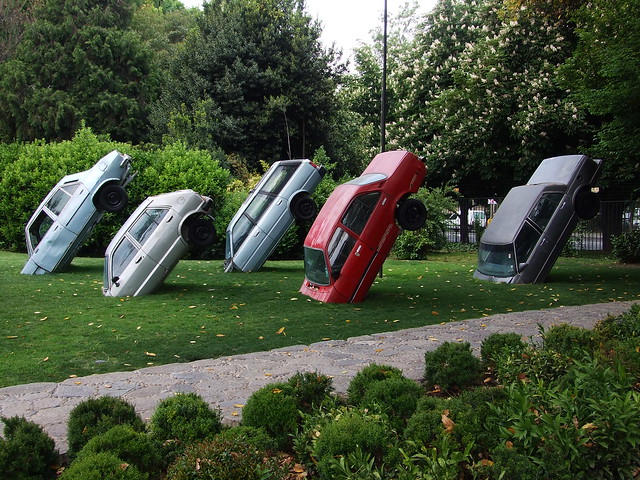
Art installation at the Museo de la Moda
(nothing to do with Chilean traffic)
After popping to the shops (it had to be done, although weirdly, I didn't buy anything), I rounded off the day with a pint in an Irish pub with one of my classmates. Horror of horrors though, it was an Irish pub that didn't sell Guinness! How is that even allowed under the trade descriptions act? Still, the local brew went down equally as well.