Monday, 3 January 2011

Watching the sun set on 2010

The last sunset of 2010 - Viña del Mar
New Year's Eve can often be a bit of a damp squib. All the anticipation and hype inevitably, at times, leads to anticlimax and disappointment, leaving you wondering what all the fuss had been about.

Happily, this year, my new year celebrations were far from disappointing. Admittedly, I was a little nervous, as lots of people had said to me how amazing it would be to see in the new year in a different country, and somewhere hot! Thankfully, it did not let me down.

Having spent the day at the seaside, we made our way to relatives of Carlos' who have a beach view flat at the resort of Viña del Mar. The resort is across the bay from Valparaíso and together they are the setting for what are said to be some of the most spectacular fireworks displays in the world.

Before dinner, we took a walk on the beach with the children and got to see the final sunset of the year, turning a golden orange before dropping below the cliffs. Carlos and I repeated the scene on New Year's Day - sitting on a rock watching the first sunset of 2011.

Then it was back to the flat for - what else? - a barbecue. The ubiquitous choripan (hotdogs) followed by a hunk of beef. I attempted a tequila cocktail, which was brave, given a slight incident shortly after completing my A-levels... all went well.

As midnight approached, the anticipation grew and Carlos and I found ourselves feeling quite nervous. In keeping with Spanish tradition, we each clutched a small bowl of 12 grapes, which would accompany the bongs of the clock in the countdown to the new year. Unfortunately, in a minor oversight, we discovered that Chile doesn't count down to new year with clock bongs, so we had to stuff them into our mouths as quickly as possible as the crowd on the TV counted down from 10.

Out on the balcony, a huge cheer ran across the bay, a rain of ticker-tape and silly string covered us, the champagne bottle popped and it was hugs, kisses and felicitations all round. Then a pause, almost silence, as thousands of people looked at a black sky, lit only by a few floating Chinese lanterns. Where were the fireworks?

Perhaps a minute passed, and then, an enormous explosion. Cascading colours lit up the sky, with a cacophony of noise from the bangs of the fireworks, cheers and gasps from the spectators, honks from hand-held klaxons and the ships in the bay and the blaring of car alarms. The Pacific Ocean was illuminated in pinks, greens, reds, whites and golds as vivid displays from 10 or more platforms in the sea erupted simultaneously. The spectacular show lasted for 25 minutes and was truly, one of the most amazing things I've ever seen.


Video from: http://www.youtube.com/watch?v=tuBYF1pYuIo&feature=related

What a year for Chile... and for me

2010 - a year of huge ups and downs for Chile. For me - a year of life-changing experiences.

It's not often in life you are given the opportunity to do something completely new. To actually realise a dream you may have had, or half had, for years, never really thinking it was achievable. But for me, 2010 presented just that; an opportunity to live abroad, to visit south America, to immerse myself entirely in a new culture and language.

For my newly adopted country, 2010 was, to put it mildly, an interesting year. Many of us in the northern hemisphere probably learned more about Chile in the media last year than ever before, as for both good and bad reasons, it made headlines. Certainly, nothing ordinary happened.

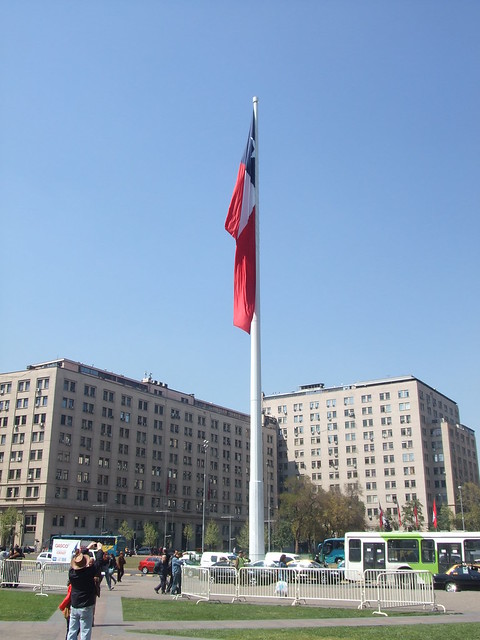
The great Chilean flag
To start with, 2010 was Chile's bicentenary. 200 years ago, on the 18th September 1810, a group of Chilean-born citizens began the process of independence from Spain. To mark the occasion, an extensive programme of events was planned: an enormous national flag was proudly unfurled in the centre of Santiago; a new museum of memory and human rights opened to remember victims of the military dictatorship; over 17 million trees were planted, one native species for every Chilean; several national monuments and public spaces were overhauled and revitalized, including Santiago Cathedral; construction started on a national network of bicycle paths - 690 miles worth; and various cultural and artistic events took place, including the special performance of The Nutcracker in the grounds of La Moneda.

It was due to be a year of great excitement, hope and celebration. Then out of nowhere, on February 27th, at 3:34 local time, a massive earthquake struck the country. Measuring 8.8 on the Richter Scale, the quake affected large swathes of the country and triggered a devastating tsunami that destroyed extensive areas of the coast. The infrastructure, including the main route connecting the capital with the south of the country, was badly damaged. Hundreds of thousands of people were made homeless, food was scarce, the drinking water supply contaminated and a complete blackout lasted for several days. A state of national catastrophe was declared.

However, despite the severity of the quake (bigger than the Haiti quake earlier in the year), Chile quickly set-about the task of re-building. And the nation showed its strength and solidarity in a special Telethon, named Chile helps Chile, which raised double its target to kick-start the country's recovery. In total, over 50 billion Chilean pesos was collected (that's over 68.5 million pounds).

Two weeks after the earthquake, a new president assumed office. Sebastián Piñera, a media mogul and one of the country's richest people, is Chile's first democratically elected right-wing president since 1958. This was a major political shift, which saw him replace the hugely popular Michelle Bachelet, who left office with an approval rating of around 80% (the Chilean Constitution prevents presidents from serving consecutive terms).

In June, there was some light relief and great excitement as Chile took part in the World Cup for the first time since 1998. The national team, 'La Roja', played some impressive football, eventually losing to Brazil in the second round.

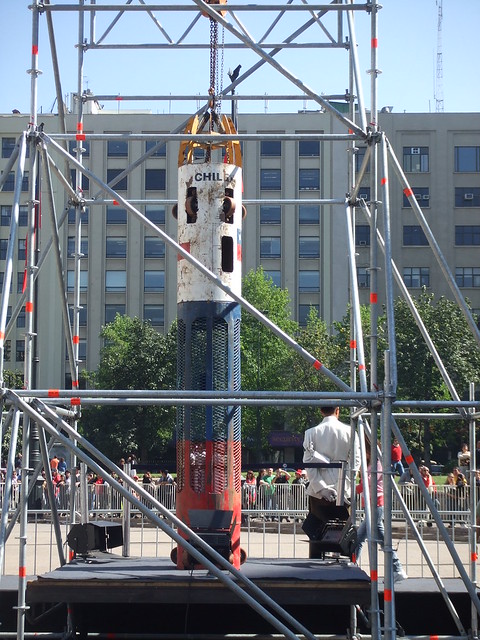
The miners' rescue capsule
Then in August, Chile hit the headlines of the world, with the news of 33 miners, trapped at a depth of 700 meters when the mine they were working in collapsed, were found alive and well after 17 days. They of course went on to spend a total of 69 days underground before being dramatically rescued on October 13th. The eyes of the world were on Chile and the miners and their families received the fairytale ending they could probably never have imagined.

But the emotional rollercoaster didn't end there. Tragedy struck again in December when a fire in an overcrowded prison killed 81 inmates. While a second Telethon raised over 18 billion pesos, uniting the country once again in a drive to help disabled children.

Any one of these events would have been enough for a country. So what will 2011 have in store for Chile? After a year of jubilation, despair, tragedies and fairytale endings, perhaps the citizens of this country are hoping for something a little less out-of-the-ordinary.

Saturday, 25 December 2010

The strangest Christmas

Christmas has taken me somewhat by surprise this year. The first time I realised it was coming was earlier this month when, while battling through Santiago's busy shopping district in sweltering heat, I noticed pictures of snowflakes in shop windows. "Snowflakes?", I thought, "but it's not ski season any more." And then it hit me - this was Christmas in the southern hemisphere. Temperatures may peak at 33 degrees on Christmas Day but the image of a winter wonderland pervades.

Thanks to Ruth for the little reminder of
Christmases past - a poinsettia
And yet it doesn't feel like Christmas. Dutifully, Santa sits in shopping malls, robed in a thick red coat, boots and fake white beard, surrounded by Christmas trees, brightly wrapped presents, reindeer, snow and helper elves, but it seems out of place somehow (and my goodness he must be hot). My language school hung some paper garlands and installed a massive Christmas tree in reception; lovely to look at, but strangely incongruous against the 'hot country' building design of white plaster walls, light wood, cacti and palms. Christmas lights adorn the city streets, but they don't accompany any Christmas shopping trips, because it doesn't get dark until 9.30pm.

I guess that this must be normal for Chile, but for me, and for all of my northern hemisphere friends, it's just plain weird. There are two reasons as I see it. Firstly, Christmas isn't as prominent. Yes, there are adverts everywhere, decorations, lights, special food in the supermarkets and Christmas songs in the shops, but this doesn't start until at least the 1st of December. A very welcome and refreshing change to the flood of Christmas merchandising that appears before the school holidays are even over in the UK. Secondly, it's hot! It's summertime and the kids are enjoying their long holiday from school. So why do Christmas cards here feature snow-filled scenes, when that is never, ever going to be reality? Why not have Santa on the beach?

And this, I think, is the strangest thing for me to get my head around. Yesterday, I sweated over a pan of hot mulled wine while wearing shorts. For me, and I think for anyone who is accustomed to celebrating Christmas in the northern half of the world, the brain cannot compute that we should be putting up tinsel and roasting a turkey, when all we want to do is grab an ice-cream and a long cool drink in the shade. Merry Christmas from the other side of the world!

Wednesday, 22 December 2010

Bringing culture to the masses

One of the things I'm really starting to love about Santiago is the amount of free cultural events that are on offer. There always seems to be something going on, from ballet, to opera, to classical concerts, as well as outdoor art exhibitions and craft fairs. I guess the lack of rain here makes it easy to rock-up to the nearest public space and put on a show...

What is interesting, is that these events are packed. And not just with the usual crowd you would expect at an opera or a ballet. All of Santiago is there: families with small children, cool looking guys whose usual domain is reggaeton, girls on their way to a night out and pairs of blokes who on a Saturday night you'd expect to be in the pub. It seems there is a real hunger to experience culture here and it's fantastic that it's made accessible.

'The Nutcracker' with images projected onto La Moneda

This weekend it was the turn of festive favourite 'The Nutcracker' (or El Cascanueces). Performed by the amazing Santiago Ballet, accompanied by the equally brilliant Santiago Philharmonic Orchestra (the same team behind last month's production of 'Swan Lake'), it was another marvellous spectacle.

The setting was Plaza de la Constitucion, the central square in front of La Moneda, the presidential palace. With wondrous effect, this magnificent piece of architecture was used as a backdrop to the ballet - with dazzling images projected onto the white walls of the palace. Each sequence of light was greeted with a tantalized 'oooh' from the crowd.

The final scenes of 'The Nutcracker'

Meanwhile the dancing, of course, was superb. I was a long way from the stage, so the twirling figures were minute, but somehow they manage to draw you in, enthralling you with their delicate and intricate movements. The ballerinas displayed their prowess with numerous different styles, from a flamenco-inspired piece, to an almost rumba-esque section, to Russian dancers, a fight scene, puppets and robots. All culminating with the most familiar piece of "Nutcracker music", the lone ballerina pirouetting and leaving the crowd spellbound as if they had just discovered a music box for the first time. A real Christmas treat.

Saturday, 18 December 2010

Mendoza

Forgive the delay in writing for a while; it has been a pretty crazy couple of weeks here, in between being extremely ill with my first taste of Chilean flu, finding myself in charge of a 24 hour news service and needing to make a trip to Argentina.

So Mendoza, as this post is titled, is the first city across the border from Santiago in Argentina. It is reached by the most spectacular mountain pass - which heads straight up and over the Andes. Vehicles have to snake around a twisting road that traverses what feels like a sheer drop. While the border, along with immigration control and customs, can be found at a height of around 3200 metres.

Mendoza mountain pass

We made the journey by coach, a sizeable journey that took 9 hours on the way there due to late night roadworks (just 6.5 on the way back). Thankfully, it wasn't as tortuous as I had imagined. The semi-cama or semi-bed service had comfortable seats which reclined into a sleeping position. We were served a sandwich and a cold drink upon departure, which was followed up after the border crossing by a cup of tea or coffee (yes, tea!) and a biscuit (this is a Chilean style biscuit - with lashings of dulce de leche or manjar and chocolate, yum). On the return journey, we were also treated to a film. I guess in a country as big as Chile, it's expected that long-distance coach journeys should be bearable a experience. Thankfully, they are.

So having travelled overnight, we reached Mendoza in the early hours of Saturday morning. It's a beautiful city; small, quiet, calm, very green with lots of trees and not a lot of traffic. A complete contrast to the hurly-burly of car horns and pollution that is Santiago. The city is structured around five main squares - Plazas de Independencia, Chile, Italia, España and San Martin - all beautifully landscaped and lovely places to sit and watch the world go by. We took in them all over the course of the weekend.

To start us off on Saturday morning, we had a very interesting guided tour at a panoramic viewpoint run by the tourist information centre. It provided a 360 degree view of greater Mendoza, extending to the Andes in the west, with sweeps of green city boulevards giving way to swathes of vineyards. Then in the afternoon, we visited a magnificent park, home to Cerro Gloria which we climbed to enjoy more great views.

11th December was the national day of tango in Argentina, so after eating a very filling meal of veal in breadcrumbs with chips, we rounded off the day by heading to the heart of the city to see some fine tango.

Sundays are quiet in Mendoza, so we decided to step back in time by hitching a ride on a trolley bus (yes, really). Then it was time for us to head back to Chile, travelling back over the mountains only this time in daylight. Truly, one of the most spellbinding journeys I have ever had the chance to enjoy.
See my Mendoza photos on Flickr

www.flickr.com

jaynescarman's Mendoza photoset jaynescarman's Mendoza photoset

Saturday, 4 December 2010

27 hours of love

As I write, Chile is slap-bang in the middle of its Teletón - a major national fundraising event that seeks to unite the entire country in order to raise money for children and young people with disabilities.

It's a bit like Children in Need or Comic Relief, only I would say on a much grander scale. The TV marathon starts at 10pm on Friday night and goes right through until the small hours of Sunday morning. There are acts throughout the period - music, dance, comedy, even strippers (apparently) at one point - as well as a celebrity football match and of course, lots of heart-breaking stories of struggle, rehabilitation and hope.

But it's more than that, it feels like the entire country gets involved in the Teletón. As an adult, I think, it's often quite easy for the British telethons to pass you by. You can simply not tune in to BBC1 on that evening, and if your workplace isn't one that does a lot for charity, and you don't have children to remind you that their school is organising something, you could be forgiven for not realising there was any kind of fundraising effort taking place at all.

Here, things are different. For the last month or so, there has been a huge advertising campaign - billboard-size posters in the Metro, Teletón packaging on all the well-known brands and TV commercials across all networks to remind you that the 3rd and 4th of December is Teletón. Then in the last week or so, hand-painted adverts have started appearing on the rear windows of people's cars, on buses even. The people here are moved to get involved. There is no way you escape the call for Chile, un solo corazón (Chile, one heart).

Last night I watched the opening ceremony; I set a new record (even for me) of starting to blub my eyes out around 10 seconds in. I really shouldn't watch these kind of programmes. Of course, this has been a momentous year for Chile, with the massive earthquake in February, a change in government and the rescue of the San Jose miners, all taking place in its Bicentenary - 200 years since the process of independence from Spain began.

But what was really amazing to me, was I couldn't have not watched the Teletón - it was on every single TV channel in the country. Friday night in Santiago was eerily quiet. I usually get very little sleep at the weekend because Chileans love a good party to end the week - with loud music, singing and dancing regularly going on until 3 or 4am. Yet last night - not a peep; with the exception of an occasional chorus of cheers and shouts. And I knew exactly what was prompting those cheers and shouts, because I was watching too. Truly, a nation united in solidarity - Chile, one heart.

Thursday, 2 December 2010

I felt the earth move

Ok, I've decided to tackle a subject here that I've shied away from previously, because at times when I have mentioned it in the past it has provoked quite a strong reaction. The subject: earthquakes.

Here in Chile, earthquakes are a fact of life. Most likely, you will have seen in the news that Chile had a major earthquake back in February this year. In that particular case, the magnitude was exceptional. But a gentle shaking of the earth here is a regular occurrence.

I experienced my first tremor around four days after I arrived. I was sitting on the sofa when I heard an odd creaking noise in the kitchen. My first thought was that something may have fallen down or come in through the window. But then 30 seconds later I felt the floor and the sofa shake. It couldn't have lasted for more than 10 seconds and was nowhere near as strong as those we've had in Birmingham in recent years.

Since then there have been countless tremors, or rather delightfully 'tremblers' as they are sometimes called. I've been aware of two or three and there have been many more while we've been asleep/on the Metro/out and and about. What prompted this post was another one this morning and I can only describe it as feeling like someone had grabbed hold of the bottom of the sofa and shaken it from side to side.

So there you have it. Unfortunately, I couldn't write a blog about my time here in Chile without mentioning earthquakes, they are so common that no-one is phased when the earth moves. In fact, some colleagues of a friend of mine simply grinned and said: "Welcome to Chile. Get used to it." (Thanks Emma)