I could write about nothing else today other than the first anniversary of the great Chilean earthquake of 2010.
At 3.34am on February 27th 2010, a massive earthquake measuring 8.8 on the Richter scale hit Chile. Its epicenter was just offshore from Cobquecura, a small town in the central-southern part of the country. Around 30 minutes later, massive tsunami waves triggered by the quake hit Chile's coast, destroying large parts of the country's second city Concepción.
Here in the capital city of Santiago, where the quake measured around 8.0, there was surprisingly little damage. While lots of buildings suffered some surface damage, there was little in the way of major structural problems. Testament to this, our flat had some sizeable cracks in its central walls and a few tiles that had fallen off when we moved in. And like many people we know, our doors don't close properly and the windows don't open without a fight. But the building is standing and sturdy. Reports in the news say that it was business as usual in Santiago after only a couple of days.
In total, the earthquake caused the deaths of 524 people, left 31 missing and 800,000 homeless. But what's amazing, is that these numbers are pretty small. Compare it to the Haiti earthquake just six weeks earlier; this measured 7.0 on the Richter scale, but is thought to have killed over 300,000 people, injured a further 300,000 and left 1 million people homeless. This just goes to show how well prepared Chile is. It understands the risks of its location and knows how to deal with them.
Read my articles about the February 27th earthquake on I Love Chile:
Sunday, 27 February 2011

Sunday, 20 February 2011
Music
"We live on the wrong side of the Atlantic". That is the conclusion Carlos and I have reached, at least when it comes to music anyway.
Since arriving in Chile, we have already had the unique opportunity to see salsa legend Willie Colon - a true honour to be in the presence of one of the founding fathers of salsa music as we know it. Last night, we added modern day latin superstar Marc Anthony to the list. What a show that was; a true performer - theatrical and charismatic - completely at home with hordes of screaming girls, but also a consummate musician with an astonishingly powerful voice and superbly talented band.
With bachata group Aventura on the cards too, we are enjoying rare opportunities to see artists who just don't cross the Atlantic, or at least, not as far as the UK. For anyone who is into salsa or latin music in general, we are being afforded treats that are hard to come by back home.
As well as great live performances, something else we'll miss is the mainstream nature of salsa here - or more correctly reggaeton. Reggaeton is massively popular, dominating many radio stations, and is usually the music of choice whenever one of our neighbours wishes to share their record collection with the rest of the building. 4am parties aside, it's great to hear the type of music we can only get in specialist clubs in the UK, whenever we feel like it.
Video from keka1209 via YouTube
 |
| Marc Anthony |
With bachata group Aventura on the cards too, we are enjoying rare opportunities to see artists who just don't cross the Atlantic, or at least, not as far as the UK. For anyone who is into salsa or latin music in general, we are being afforded treats that are hard to come by back home.
As well as great live performances, something else we'll miss is the mainstream nature of salsa here - or more correctly reggaeton. Reggaeton is massively popular, dominating many radio stations, and is usually the music of choice whenever one of our neighbours wishes to share their record collection with the rest of the building. 4am parties aside, it's great to hear the type of music we can only get in specialist clubs in the UK, whenever we feel like it.
Video from keka1209 via YouTube
Sunday, 6 February 2011
Food
People often ask me what the food is like in Chile - what is different and what do I miss. Saving what I crave for another post, I will focus on some of the foods that I'm going to be very sorry to have to say goodbye to.
Sopaipillas
A circle of deep-fried filo pastry made with courgette and served with pebre - a hot salsa of garlic, tomato, onion and herbs. A lady sells them on our street during the evening commute home and Carlos and I have become thoroughly addicted to them. They are so tasty!
Alfajores
Chileans know how to do sugar and the alfajor is no exception. Two layers of very crumbly biscuit are stuck together with manjar and covered in chocolate or icing sugar. Manjar or dulce de leche is a thick, sticky mixture of evaporated milk and sugar. Ubiquitous in Chile, just imagine any pudding or cake, stick manjar in it, and you have a Chilean postre (dessert).
Asado
I have written about the delights of the asado before but I had to give it a mention here. Asado translates as barbecue but it is essentially a meat feast, washed down with lashings of red wine. The staple food is a choripan - a hotdog made from a chorizo or longaniza spicy sausage within a marraqueta, a type of bread that handily breaks down into two or four hotdog-sized rolls. When we can't get out on the roof to the quincho (barbecue range) Carlos and I have taken to having oven-baked asados on a weekend instead.
Sushi
By far the most common form of fast food here (apart from the completo) is sushi. Amazing as it sounds, particularly as there is almost no Japanese community here in Chile, sushi restaurants can be found on practically every street in Santiago. I'd read a lot about the Chilean twist on sushi, which was that it is unusually laced with cream cheese and avocado (see below). I had my first sushi experience last night and found it all pretty yummy.
Completo
Whisper this quietly, but I am not a big fan of the completo. However, I could not write a post about Chilean food without mentioning it. The completo is a frankfurter-style hotdog, slathered in tomatoes, avocado and mayonnaise. Tomato and avocado are a staple part of the diet here - no meal is complete without them. I've tried and failed with the completo (probably something to do with the fact that I'm not a fan of frankfurters, mayonnaise or fresh tomatoes!) and am admitting defeat on this one.
Pisco sours
Not a food as such, but I'm developing a weakness for Chile's national drink. Pisco is a super-strong liquor but the 'sour' (lemon or lime juice) makes it wonderfully refreshing. A foamy top is made from egg white and then completed with a dash of orange-coloured bitters (thanks Wikipedia for that information).
With all that talk of my favourite Chilean foods I'm now salivating with hunger; if only the sopaipilla lady was there on a Sunday afternoon!
 |
| Sopaipilla |
A circle of deep-fried filo pastry made with courgette and served with pebre - a hot salsa of garlic, tomato, onion and herbs. A lady sells them on our street during the evening commute home and Carlos and I have become thoroughly addicted to them. They are so tasty!
Alfajores
 |
| Alfajores |
Chileans know how to do sugar and the alfajor is no exception. Two layers of very crumbly biscuit are stuck together with manjar and covered in chocolate or icing sugar. Manjar or dulce de leche is a thick, sticky mixture of evaporated milk and sugar. Ubiquitous in Chile, just imagine any pudding or cake, stick manjar in it, and you have a Chilean postre (dessert).
Asado
 |
| Choripanes |
Sushi
By far the most common form of fast food here (apart from the completo) is sushi. Amazing as it sounds, particularly as there is almost no Japanese community here in Chile, sushi restaurants can be found on practically every street in Santiago. I'd read a lot about the Chilean twist on sushi, which was that it is unusually laced with cream cheese and avocado (see below). I had my first sushi experience last night and found it all pretty yummy.
Completo
 |
| Completo |
 |
| Pisco sour |
Not a food as such, but I'm developing a weakness for Chile's national drink. Pisco is a super-strong liquor but the 'sour' (lemon or lime juice) makes it wonderfully refreshing. A foamy top is made from egg white and then completed with a dash of orange-coloured bitters (thanks Wikipedia for that information).
With all that talk of my favourite Chilean foods I'm now salivating with hunger; if only the sopaipilla lady was there on a Sunday afternoon!
Sunday, 30 January 2011
Wool
An unexpected delight here in Chile is wool. As a self-confessed knitting addict, I'm sadly a little unusual in the UK. Spending my free time listening to the click of the needles is not something most 28 year olds choose to do.
But here, it's a whole other story. I first had an inkling that my hobby might be a little more conventional when Carlos told me of a conversation he'd overheard between two of his work colleagues, not long after he'd arrived, about the current knitting projects they had on the go. Even more surprisingly, he caught one of the secretaries grabbing a sneaky couple of rows during a quiet moment at the office.
When the Metro is not packed to the rafters, it's not uncommon to see women whip out their knitting. The idea of donning a ball of wool in public may seem a little cringe-worthy in the UK, but here no-one bats an eyelid.
The best thing by far though, is wool shops. And I mean proper little wool shops of the kind I used to see as a child in the 80s, that regrettably, almost completely died out. Gorgeous shelves full of brightly-coloured, inexpensive yarns and stocked with all the accoutrements you could need; needles, magazines, patterns and all. They are everywhere: metro stations, big American-style malls, little shopping areas, side streets and main thoroughfares. It really is a dangerous city to live in...
Footnote for the yarn connoisseur: Knowing that some of my readers are as crafty as I am, I felt I must mention the local yarn here which many of you may be familiar with: Araucania yarns. Araucania yarns are a collective of artisans based in Santiago that hand-dye exquisite alpaca, angora and Patagonian wool, among other fibres. They produce some seriously beautiful variegated yarns.
Last Monday, I had the joy of seeing the yarns close-up when some of the knitting groups girls and I treated ourselves to a trip to Cuenta Puntos, a local stockist of Araucania. It's a shop that was rather deliciously described by one of the girls as 'yarn porn' - need I say any more?
But here, it's a whole other story. I first had an inkling that my hobby might be a little more conventional when Carlos told me of a conversation he'd overheard between two of his work colleagues, not long after he'd arrived, about the current knitting projects they had on the go. Even more surprisingly, he caught one of the secretaries grabbing a sneaky couple of rows during a quiet moment at the office.
When the Metro is not packed to the rafters, it's not uncommon to see women whip out their knitting. The idea of donning a ball of wool in public may seem a little cringe-worthy in the UK, but here no-one bats an eyelid.
The best thing by far though, is wool shops. And I mean proper little wool shops of the kind I used to see as a child in the 80s, that regrettably, almost completely died out. Gorgeous shelves full of brightly-coloured, inexpensive yarns and stocked with all the accoutrements you could need; needles, magazines, patterns and all. They are everywhere: metro stations, big American-style malls, little shopping areas, side streets and main thoroughfares. It really is a dangerous city to live in...
 |
| Photo by Nagamori (cc) |
Last Monday, I had the joy of seeing the yarns close-up when some of the knitting groups girls and I treated ourselves to a trip to Cuenta Puntos, a local stockist of Araucania. It's a shop that was rather deliciously described by one of the girls as 'yarn porn' - need I say any more?
Sunday, 23 January 2011
Sampling all aspects of Chilean life
Me being me it was going to happen eventually: I was going to wind up in an A&E department and have the opportunity to learn about the Chilean health system first hand. But before anyone panics, nothing serious has happened.
On Friday morning I noticed I had some insect bites on my arm. Nothing out of the ordinary there, as I seem to be a pretty tasty dish of foreign cuisine to the local nippers. The great thing about Chile though is that there are very few animal-related things that can harm you, especially without you realising it. As far as unidentified bites and stings go, there is no malaria or similar mosquito-carried diseases, no poisonous snakes and no deadly scorpions. All there is, are two poisonous spiders, and only one of these lives in the city.
The city spider is the araña de rincon or brown recluse. Fortunately for us humans, it's not aggressive and doesn't go biting humans willy-nilly. It hunts at night and has a habit of running away if it gets startled, usually into the nearest nook, frequently a pile of clothes or bedsheets. Herein lies the danger, the spider only bites if it gets attacked - i.e. squashed - so if you roll onto it or put your shoes on without shaking them first you might be in trouble.
Back to my story, over Friday and Saturday, around the place where I had two bites close together, a red patch had begun growing outwards in a circle and was becoming more and more swollen and itchy. Now, I've had bites similar to this before, which a very well-travelled friend of mine had believed to be spider bites. Knowing what I know about the rincon, I was more than a little concerned.
So on late Saturday afternoon, after a call to the insurance company and some rather grisly research on the internet (sometimes I wish we didn't have the internet and all the gruesome pictures and tales it provides - not that I'm being much better myself here) I decided I'd better take myself off to Clinica Alemana.
Still a little confused about how you actually access medical care, from what I can gather, there are a number of super-clinics, which provide A&E, hospital treatment and general GP appointments. Clinica Alemena is one of the three most super-duper of these super clinics and recommended for gringos as they advertise that they speak English (among other languages).
Nonetheless, I took my trusty translator with me, and thank goodness I did. While I managed to see a doctor who spoke English, the receptionists did not, and were rather less than pleased when we deigned to ask them whether they might. Medical receptionists seem to be the same wherever you go then... (sorry medical receptionists, I'm sure it's only a small minority but I do seem to pick them at times).
I was seen very swiftly - not even time to sit down in the waiting room - and was ushered into a very clean and modern treatment area. A couple of preliminary heart rate and blood pressure checks (although oddly no medical history questions) and then a short wait until the doctor breezed in, took one look at my arm and told me it wasn't a spider (phew all round) and just a nasty allergic reaction. All that was needed was a mega-dose of antihistamines and anti-inflammatories and I was off again.
Overall, I think I was in the hospital maybe an hour and a half at most. A far cry from the usual four hours in A&E you can expect to spend in the UK. Although I was paying for the privilege. The building was new, fresh, light and modern, very clean and set in lovely grounds. It had a calm atmosphere and the staff were in general very courteous and nice. The one odd aspect being the branding was very similar to that of Sainsbury's - red, orange and purple banners, the same font and white writing on windows. I was a little confused at one point whether I was actually in a Sainsbury's cafe or a hospital.
On Friday morning I noticed I had some insect bites on my arm. Nothing out of the ordinary there, as I seem to be a pretty tasty dish of foreign cuisine to the local nippers. The great thing about Chile though is that there are very few animal-related things that can harm you, especially without you realising it. As far as unidentified bites and stings go, there is no malaria or similar mosquito-carried diseases, no poisonous snakes and no deadly scorpions. All there is, are two poisonous spiders, and only one of these lives in the city.
The city spider is the araña de rincon or brown recluse. Fortunately for us humans, it's not aggressive and doesn't go biting humans willy-nilly. It hunts at night and has a habit of running away if it gets startled, usually into the nearest nook, frequently a pile of clothes or bedsheets. Herein lies the danger, the spider only bites if it gets attacked - i.e. squashed - so if you roll onto it or put your shoes on without shaking them first you might be in trouble.
Back to my story, over Friday and Saturday, around the place where I had two bites close together, a red patch had begun growing outwards in a circle and was becoming more and more swollen and itchy. Now, I've had bites similar to this before, which a very well-travelled friend of mine had believed to be spider bites. Knowing what I know about the rincon, I was more than a little concerned.
So on late Saturday afternoon, after a call to the insurance company and some rather grisly research on the internet (sometimes I wish we didn't have the internet and all the gruesome pictures and tales it provides - not that I'm being much better myself here) I decided I'd better take myself off to Clinica Alemana.
Still a little confused about how you actually access medical care, from what I can gather, there are a number of super-clinics, which provide A&E, hospital treatment and general GP appointments. Clinica Alemena is one of the three most super-duper of these super clinics and recommended for gringos as they advertise that they speak English (among other languages).
Nonetheless, I took my trusty translator with me, and thank goodness I did. While I managed to see a doctor who spoke English, the receptionists did not, and were rather less than pleased when we deigned to ask them whether they might. Medical receptionists seem to be the same wherever you go then... (sorry medical receptionists, I'm sure it's only a small minority but I do seem to pick them at times).
I was seen very swiftly - not even time to sit down in the waiting room - and was ushered into a very clean and modern treatment area. A couple of preliminary heart rate and blood pressure checks (although oddly no medical history questions) and then a short wait until the doctor breezed in, took one look at my arm and told me it wasn't a spider (phew all round) and just a nasty allergic reaction. All that was needed was a mega-dose of antihistamines and anti-inflammatories and I was off again.
Overall, I think I was in the hospital maybe an hour and a half at most. A far cry from the usual four hours in A&E you can expect to spend in the UK. Although I was paying for the privilege. The building was new, fresh, light and modern, very clean and set in lovely grounds. It had a calm atmosphere and the staff were in general very courteous and nice. The one odd aspect being the branding was very similar to that of Sainsbury's - red, orange and purple banners, the same font and white writing on windows. I was a little confused at one point whether I was actually in a Sainsbury's cafe or a hospital.
Sunday, 16 January 2011
Christmas fun: wine
What's the one thing Chile is probably most famous for in the UK? Ok, apart from its political history and the miners. The answer: wine of course! Chile has had a reputation for a few years now of producing decent wine at affordable prices. So with vineyards aplenty right outside Santiago, what better way to spend an afternoon than sampling the local export?
Probably the most commercial of the wineries here is Concha y Toro. I'm sure many of you are familiar with its wine, as one of the company's biggest export countries just happens to be the UK. Located on the outskirts of Santiago, in a nice little village called Pirque, Concha y Toro has seen the potential in the tourist market and grabbed it.
The vineyard is set in some lovely grounds, its administrative base occupying what was once a summer house amid an English country garden of gently undulating hills, a boating lake, mature trees and roses. Beyond the country pile, the landscape gives way to acres of vines, spreading out towards the foothills of the Andes.
On our tour of the vineyard, we got to sample a beautifully fresh white from the new range 'Trio', which, unsurprisingly, is a blend of three grapes. We learnt how to taste wine properly, swirling the glass to release the flavour, giving it a good old nose, and then taking a sip. And it really did taste of green apples, just as our tour guide said it would! Thankfully, we didn't have to spit it out and were allowed to enjoy the rest of the glass as we ambled through the grounds.
Our tour concluded at the Casillero del Diablo - another of the company's famous brands - which is actually the cellar where the founder of Concha y Toro, Don Melchor, kept his best wines. Myths and legends abound in this place, but the highlight was the chance to taste one of the premium wines, the Don Melchor, a hearty, beefy red which left me a little wobbly as I tottered round the gift shop.
 |
| Enjoying a nice glass of Chilean red |
The vineyard is set in some lovely grounds, its administrative base occupying what was once a summer house amid an English country garden of gently undulating hills, a boating lake, mature trees and roses. Beyond the country pile, the landscape gives way to acres of vines, spreading out towards the foothills of the Andes.
On our tour of the vineyard, we got to sample a beautifully fresh white from the new range 'Trio', which, unsurprisingly, is a blend of three grapes. We learnt how to taste wine properly, swirling the glass to release the flavour, giving it a good old nose, and then taking a sip. And it really did taste of green apples, just as our tour guide said it would! Thankfully, we didn't have to spit it out and were allowed to enjoy the rest of the glass as we ambled through the grounds.
Our tour concluded at the Casillero del Diablo - another of the company's famous brands - which is actually the cellar where the founder of Concha y Toro, Don Melchor, kept his best wines. Myths and legends abound in this place, but the highlight was the chance to taste one of the premium wines, the Don Melchor, a hearty, beefy red which left me a little wobbly as I tottered round the gift shop.
Wednesday, 12 January 2011
Christmas fun: sunburn
The past two Christmases I've been fortunate enough to be able to go hiking up mountains. Last year, I visited the Pyrenees and got to fool around in waist-deep snow surrounded by peaks that looked like giant meringues. This year, it was all about sunburn...
Escaping the pressure cooker that is Santiago city is fantastic. The atmosphere is clean and the air is still, free from the noise and the crowds. Travel just a few kilometres south-east and you're in the foothills of the Andes.
Getting there is really fun. Civilisation takes you as far as the outer suburbs of the city by Metro, and then it's onto a micro. Micros are quickly achieving legendary status in my mind. They are small buses, very, very old and rattly, that the driver proceeds to hurtle around country lanes at around 100km per hour. Usually the driver has music blaring - accompanied by a sign that says something like: the radio on this vehicle is fixed at an adequate volume, get used to it. And then there's the in-house entertainment. Buskers and street-sellers use the micros as a regular source of income from a captive audience - so far I've endured rappers, ice-cream sellers, plaster sellers and a clown that told homophobic jokes. Most of the time I feel dreadfully uncomfortable, but however inappropriate the clown was, I did feel sorry for him. It was a tough crowd.
 Anyway, back to the countryside. Having been dropped off in the middle of nowhere by the micro we made our way on foot to the Rio Clarillo nature reserve - a type of national park centred around a small river. A slight miscalculation on our timing meant we had an hour's walk under the midday sun from the gatehouse to the start of the reserve proper. You can guess from the title what happened.
After a spot of lunch, we went for a dip in the crystal clear spring. Now how many people can say they did that on the 28th of December? Then we headed up one of the foothills on a nature trail, a supposedly 'easy' path that had me puffing and gasping and dragging myself up by the handrail. Thankfully we were rewarded by a fabulous view, lizard-spotting and I think, on a distant craggy mountain-top, an eagle.
 The scenery was amazing, pretty green, despite the arid conditions. There were giant cacti everywhere - and I mean giant, at least twice as tall as I am. We took in another trail through an arboretum, this walk a lot more leisurely, which showcased many native tree species, including one called 'Laura'!
By late afternoon, the midges started to swarm by the river so we headed for home, the three kilometre walk back to the gatehouse feeling even more exhausting after a full day's walking. Then we hopped back on the micro and returned to the city, thankful for a day's respite and for finally having the chance to see some of Chile's gorgeous countryside.
Escaping the pressure cooker that is Santiago city is fantastic. The atmosphere is clean and the air is still, free from the noise and the crowds. Travel just a few kilometres south-east and you're in the foothills of the Andes.
Getting there is really fun. Civilisation takes you as far as the outer suburbs of the city by Metro, and then it's onto a micro. Micros are quickly achieving legendary status in my mind. They are small buses, very, very old and rattly, that the driver proceeds to hurtle around country lanes at around 100km per hour. Usually the driver has music blaring - accompanied by a sign that says something like: the radio on this vehicle is fixed at an adequate volume, get used to it. And then there's the in-house entertainment. Buskers and street-sellers use the micros as a regular source of income from a captive audience - so far I've endured rappers, ice-cream sellers, plaster sellers and a clown that told homophobic jokes. Most of the time I feel dreadfully uncomfortable, but however inappropriate the clown was, I did feel sorry for him. It was a tough crowd.
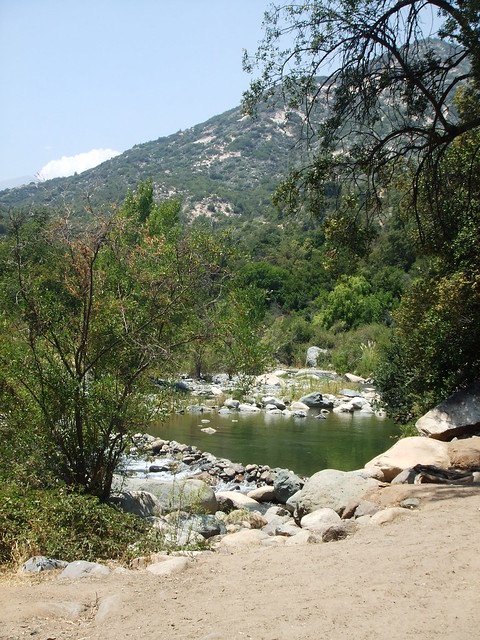
After a spot of lunch, we went for a dip in the crystal clear spring. Now how many people can say they did that on the 28th of December? Then we headed up one of the foothills on a nature trail, a supposedly 'easy' path that had me puffing and gasping and dragging myself up by the handrail. Thankfully we were rewarded by a fabulous view, lizard-spotting and I think, on a distant craggy mountain-top, an eagle.
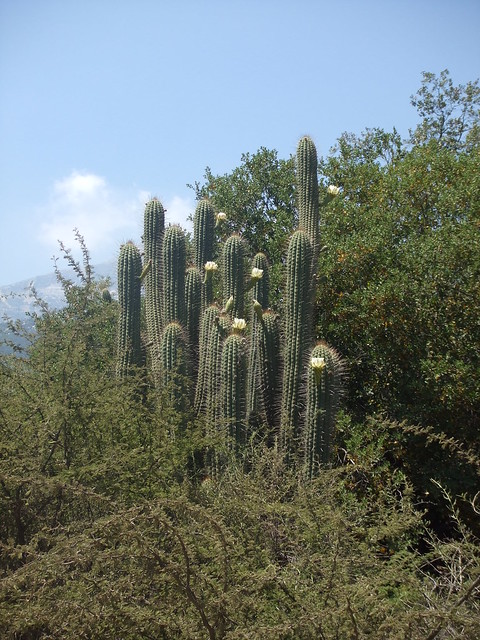
By late afternoon, the midges started to swarm by the river so we headed for home, the three kilometre walk back to the gatehouse feeling even more exhausting after a full day's walking. Then we hopped back on the micro and returned to the city, thankful for a day's respite and for finally having the chance to see some of Chile's gorgeous countryside.
Subscribe to:
Posts (Atom)